PDF · English
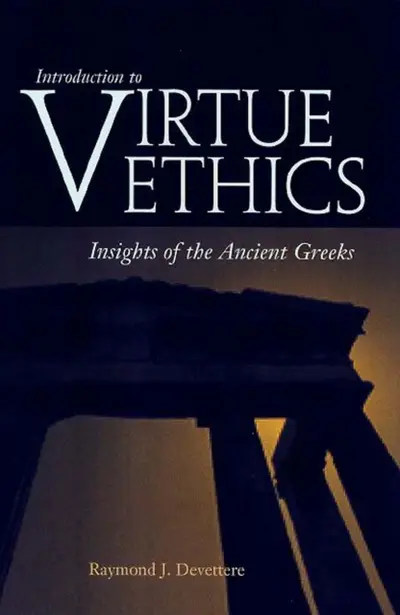
Introduction to Virtue Ethics
Insights of the Ancient Greeks
Price and availability
$37.99
Available in: Andorra, Austria, Australia, Belgium, Bulgaria, Canada, Switzerland, Cyprus, Czechia, Germany, Denmark, Estonia, Spain, Finland, France, United Kingdom, Guernsey, Greece, Croatia, Hungary, Ireland, Isle of Man, Iceland, Italy, Jersey, Japan, Liechtenstein, Lithuania, Luxembourg, Latvia, Monaco, Malta, Netherlands, Norway, Poland, Portugal, Romania, Sweden, Slovenia, Slovakia, San Marino, United States, Vatican City, South Africa
Stores: US, UK, Canada, EU, Australia.
Sign in to buyThe price is re-checked by the server before payment.
For personal use under the eBook licence.
- Format
- DRM
- Not stated by the publisher
- Language
- English
- Publisher
- Georgetown University Press
- Published
- 26 September 2002
- ISBN
- 9781589018174
- Subjects
- Ancient Greece, Western philosophy: Ancient, to c 500, Ethics & moral philosophy, Ethics and moral philosophy
About this book
<p>This fascinating examination of the development of virtue ethics in the early stages of western civilization deals with a wide range of philosophers and schools of philosophy-from Socrates and the Stoics to Plato, Aristotle, and the Epicureans, among others. This introduction examines those human attributes that we have come to know as the "e;stuff"e; of virtue: desire, happiness, the "e;good,"e; character, the role of pride, prudence, and wisdom, and links them to more current or modern conceptions and controversies. </p><p>The tension between viewing ethics and morality as fundamentally religious or as fundamentally rational still runs deep in our culture. A second tension centers on whether we view morality primarily in terms of our obligations or primarily in terms of our desires for what is good. The Greek term <I>arete</I>, which we generally translate as "e;virtue,"e; can also be translated as "e;excellence."e; <I>Arete</I> embraced both intellectual and moral excellence as well as human creations and achievements. Useful, certainly, for classrooms, <I>Virtue Ethics</I> is also for anyone interested in the fundamental question Socrates posed, "e;What kind of life is worth living?"e;</p>
Bibliographic data © Gardners Books Ltd.