PDF · English
Identity, Commodification and Revolution
Tourism and the Transformation of Society, Politics and Space in Cuba
Price and availability
$78.99
Available in: Andorra, Austria, Australia, Belgium, Bulgaria, Canada, Switzerland, Cyprus, Czechia, Germany, Denmark, Estonia, Spain, Finland, France, United Kingdom, Guernsey, Greece, Croatia, Hungary, Ireland, Isle of Man, Iceland, Italy, Jersey, Japan, Liechtenstein, Lithuania, Luxembourg, Latvia, Monaco, Malta, Netherlands, Norway, Poland, Portugal, Romania, Sweden, Slovenia, Slovakia, San Marino, United States, Vatican City, South Africa
Stores: US, UK, Canada, EU, Australia.
Sign in to buyThe price is re-checked by the server before payment.
For personal use under the eBook licence.
- Format
- DRM
- Not stated by the publisher
- Language
- English
- Publisher
- Franz Steiner Verlag GmbH
- Published
- 9 February 2024
- ISBN
- 9783515135870
- Subjects
- Geography, Geography
About this book
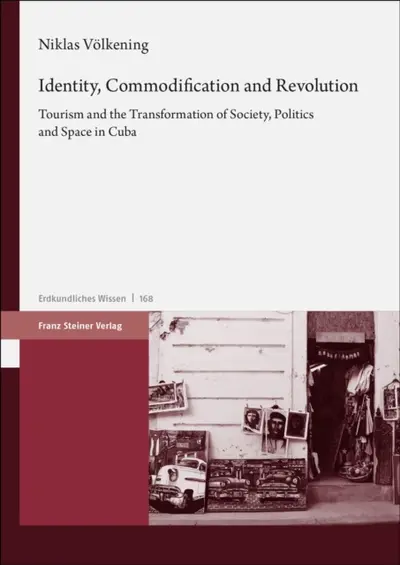
This e-book explores how the commodification of the Cuban Revolution affects Cuban identities. Contrary to prevailing beliefs, commodification does not inevitably lead to identity loss or alienation. Instead, it serves as a potent heuristic tool for comprehending social and political transformation. The Cuban Revolution, a powerful force shaping Cuban identities, presents an intriguing paradox. Surprisingly, tourism-driven commodification of the Revolution does not induce alienation, challenging prevailing assumptions. Rather, the waning identification with the Cuban Revolution stems from a complex interplay of perceived dysfunctionality, unmet aspirations, and economic inadequacies. Commodification in tourism is thus merely a symptom of alienation, revealing the discontent of marginalized individuals who criticize and disengage from the Revolution. This indicates transforming identities and socioeconomic realities, which are not caused by commodification, but are exposed through its examination. The e-book further explores the current state of the Cuban Revolution, where criticism and calls for market reforms challenge the state's authority and imply a decline in its power.
Bibliographic data © Gardners Books Ltd.