EPUB · English
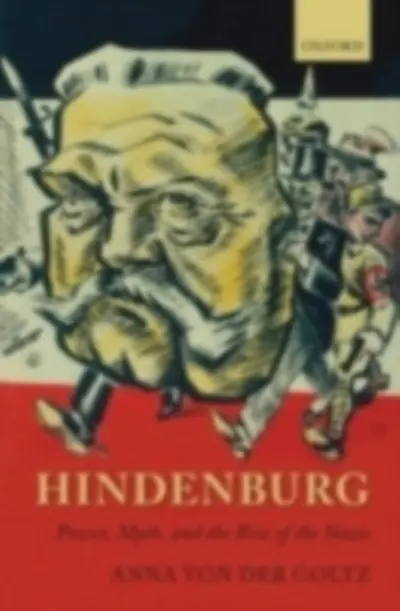
Hindenburg
Power, Myth, and the Rise of the Nazis
Price and availability
$37.99
Available in: Andorra, Austria, Australia, Belgium, Bulgaria, Canada, Switzerland, Cyprus, Czechia, Germany, Denmark, Estonia, Spain, Finland, France, United Kingdom, Guernsey, Greece, Croatia, Hungary, Ireland, Isle of Man, Iceland, Italy, Jersey, Japan, Liechtenstein, Lithuania, Luxembourg, Latvia, Monaco, Malta, Netherlands, Norway, Poland, Portugal, Romania, Sweden, Slovenia, Slovakia, San Marino, United States, Vatican City, South Africa
Stores: US, UK, Canada, EU, Australia.
Sign in to buyThe price is re-checked by the server before payment.
For personal use under the eBook licence.
- Format
- EPUB
- DRM
- Not stated by the publisher
- Language
- English
- Publisher
- OUP Oxford
- Published
- 10 September 2009
- ISBN
- 9780191610042
- Subjects
- Germany, c 1914 to c 1918 (including WW1), c 1918 to c 1939 (Inter-war period), Biography: historical, political & military, European history, 20th century history: c 1900 to c 2000, Nationalism, Fascism & Nazism, Nationalism and nationalist ideologies and movements, Far-right political ideologies and movements, European history
About this book
Hindenburg reveals how a previously little-known general, whose career to normal retirement age had provided no real foretaste of his heroic status, became a national icon and living myth in Germany after the First World War, capturing the imagination of millions. In a period characterized by rupture and fragmentation, the legend surrounding Paul von Hindenburg brought together a broad coalition of Germans and became one of the most potent forces in Weimar politics. Charting the origins of the myth, from Hindenburg's decisive victory at the Battle of Tannenberg in 1914 to his death in Nazi Germany and beyond, Anna von der Goltz explains why the presence of Hindenburg's name on the ballot mesmerized an overwhelming number of voters in the presidential elections of 1925. His myth, an ever-evolving phenomenon, increasingly transcended the dividing lines of interwar politics, which helped him secure re-election by left-wing and moderate voters. Indeed, the only two times in German history that the people could elect their head of state directly and secretly, they chose this national icon. Hindenburg even managed to defeat Adolf Hitler in 1932, making him the Nazi leader's final arbiter; it was he who made the final and fateful decision to appoint Hitler as Chancellor in January 1933.
Bibliographic data © Gardners Books Ltd.