PDF · English
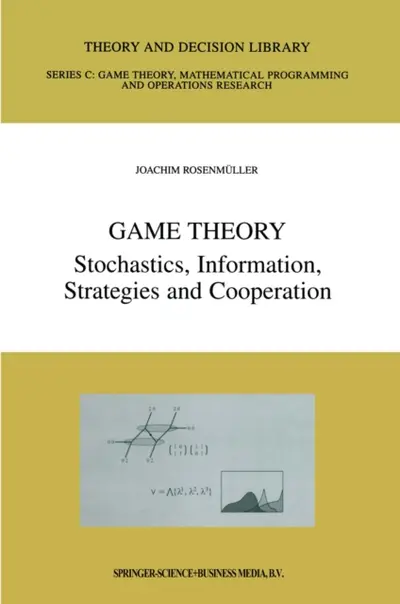
Game Theory
Stochastics, Information, Strategies and Cooperation
Price and availability
$337.99
Available in: Andorra, Austria, Australia, Belgium, Bulgaria, Canada, Switzerland, Cyprus, Czechia, Germany, Denmark, Estonia, Spain, Finland, France, United Kingdom, Guernsey, Greece, Croatia, Hungary, Ireland, Isle of Man, Iceland, Italy, Jersey, Japan, Liechtenstein, Lithuania, Luxembourg, Latvia, Monaco, Malta, Netherlands, Norway, Poland, Portugal, Romania, Sweden, Slovenia, Slovakia, San Marino, United States, Vatican City, South Africa
Stores: US, UK, Canada, EU, Australia.
Sign in to buyThe price is re-checked by the server before payment.
For personal use under the eBook licence.
- Format
- DRM
- Not stated by the publisher
- Language
- English
- Publisher
- Springer US
- Published
- 9 March 2013
- ISBN
- 9781475732122
- Subjects
- Economics, Econometrics, Game theory, Economic theory and philosophy, Econometrics and economic statistics
About this book
Game Theory: Stochastics, Information, Strategies and Cooperation provides a discussion of some relevant topics in game theory. It is composed partially from material compiled by Professor Joachim Rosenmuller when lecturing at IMW, the Institute of Mathematical Economics at the University of Bielefeld. On the other hand, it also contains research topics that are not presented in a typical game theory textbook. Thus, the volume may provide the basis for an advanced course in game theory; simultaneously it may be called a monograph, and, as a third aspect, it also supplies some rather elementary versions of advanced topics of the field. The volume has a non-cooperative and a cooperative part and in both of them the reader is assumed to have some basic knowledge in game theory, for instance, concerning the normal form (bimatrix games, Nash equilibria of the mixed extension, backwards induction in games with perfect information) on one hand and the coalitional function (simple games, convex games, superadditive games, the core, the Shapley volume) on the other hand. Some emphasis is laid on the probabilistic background; however, the author treats stochastic games using the language of probability in order to consider simple models in which measure theory can be omitted.
Bibliographic data © Gardners Books Ltd.