EPUB · English
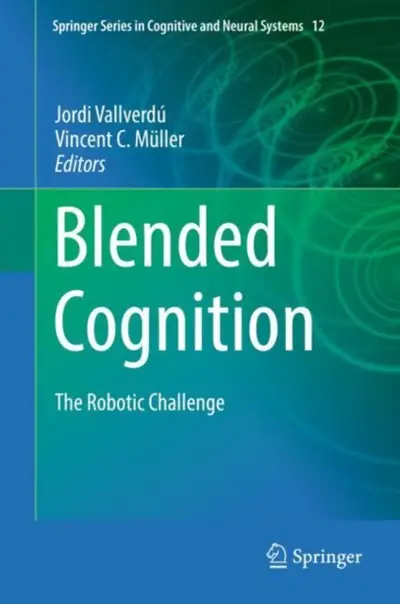
Blended Cognition
The Robotic Challenge
Price and availability
$175.99
Available in: Andorra, Austria, Australia, Belgium, Bulgaria, Canada, Switzerland, Cyprus, Czechia, Germany, Denmark, Estonia, Spain, Finland, France, United Kingdom, Guernsey, Greece, Croatia, Hungary, Ireland, Isle of Man, Iceland, Italy, Jersey, Japan, Liechtenstein, Lithuania, Luxembourg, Latvia, Monaco, Malta, Netherlands, Norway, Poland, Portugal, Romania, Sweden, Slovenia, Slovakia, San Marino, United States, Vatican City, South Africa
Stores: US, UK, Canada, EU, Australia.
Sign in to buyThe price is re-checked by the server before payment.
For personal use under the eBook licence.
- Format
- EPUB
- DRM
- Not stated by the publisher
- Language
- English
- Publisher
- Springer International Publishing
- Published
- 12 April 2019
- ISBN
- 9783030031046
- Subjects
- Cognition & cognitive psychology, Neurosciences, Artificial intelligence, Neurosciences, Computer applications in the social and behavioural sciences, Artificial intelligence (AI)
About this book
This edited volume is about how unprejudiced approaches to real human cognition can improve the design of AI. It covers many aspects of human cognition and across 12 chapters the reader can explore multiple approaches about the complexities of human cognitive skills and reasoning, always guided by experts from different but complimentary academic fields.A central concept is explained: blended cognition, the natural skill of human beings for combining constantly different heuristics during their several task-solving activities. Something that was sometimes observed like a problem as bad reasoning , is now the central key for the understanding of the richness, adaptability and creativity of human cognition. The topic of this book connects in a significant way with the disciplines of psychology, neurology, anthropology, philosophy, logics, engineering, logics, and AI. In a nutshell: understanding better humans for designing better machines.Any person with interests on natural and artificial reasoning should read this book as a primary source of inspiration and a way to achieve a critical thinking on these topics.
Bibliographic data © Gardners Books Ltd.