EPUB · English
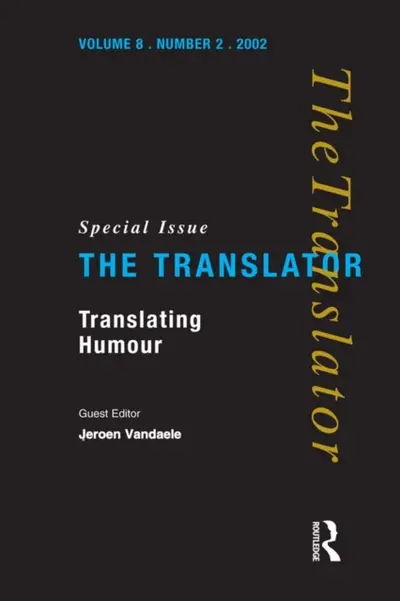
Translating Humour
Price and availability
$66.99
Available in: Andorra, Austria, Australia, Belgium, Bulgaria, Canada, Switzerland, Cyprus, Czechia, Germany, Denmark, Estonia, Spain, Finland, France, United Kingdom, Guernsey, Greece, Croatia, Hungary, Ireland, Isle of Man, Iceland, Italy, Jersey, Japan, Liechtenstein, Lithuania, Luxembourg, Latvia, Monaco, Malta, Netherlands, Norway, Poland, Portugal, Romania, Sweden, Slovenia, Slovakia, San Marino, United States, Vatican City, South Africa
Stores: US, UK, Canada, EU, Australia.
Sign in to buyThe price is re-checked by the server before payment.
For personal use under the eBook licence.
- Format
- EPUB
- DRM
- Not stated by the publisher
- Language
- English
- Publisher
- Taylor & Francis
- Published
- 8 April 2016
- ISBN
- 9781134966516
- Subjects
- Language: reference & general, linguistics, Translation & interpretation, Humour, Films, cinema, Translation and language interpretation
About this book
It is all too often assumed that humour is the very effect of a text. But humour is not a perlocutionary effect in its own right, nor is laughter. The humour of a text may be as general a characteristic as a serious text's seriousness. Like serious texts, humorous texts have many different purposes and effects. They can be subdivided into specific subgenres, with their own perlocutionary effects, their own types of laughter (or even other reactions).Translation scholars need to be able to distinguish between various kinds of humour (or humorous effect) when comparing source and target texts, especially since the notion of "e;effect"e; pops up so frequently in the evaluation of humorous texts and their translations. In this special issue of The Translator, an attempt is made to delineate types of humorous effect, through careful linguistic and cultural analyses of specific examples and/or the introduction of new analytical tools. For a translator, who is both a receiver of the source text and sender of the target text, such analyses and tools may prove useful in grasping and pinning down the perlocutionary effect of a source text and devising strategies for producing comparable effects in the target text. For a translation scholar, who is a receiver of both source and target texts, the contributions in this issue will hopefully provide an analytical framework for the comparison of source and target perlocutionary effects.
Bibliographic data © Gardners Books Ltd.