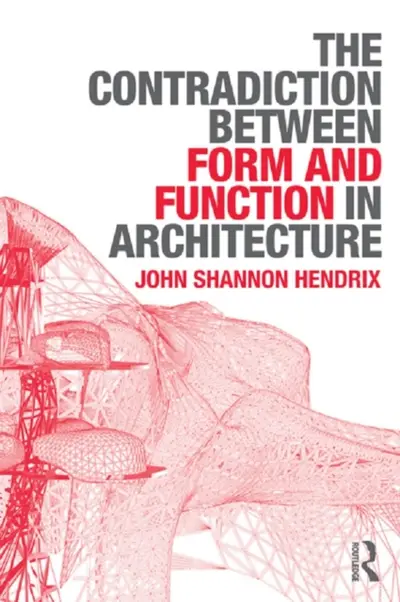
EPUB · English
Contradiction Between Form and Function in Architecture
Price and availability
$83.99
Available in: Andorra, Austria, Australia, Belgium, Bulgaria, Canada, Switzerland, Cyprus, Czechia, Germany, Denmark, Estonia, Spain, Finland, France, United Kingdom, Guernsey, Greece, Croatia, Hungary, Ireland, Isle of Man, Iceland, Italy, Jersey, Japan, Liechtenstein, Lithuania, Luxembourg, Latvia, Monaco, Malta, Netherlands, Norway, Poland, Portugal, Romania, Sweden, Slovenia, Slovakia, San Marino, United States, Vatican City, South Africa
Stores: US, UK, Canada, EU, Australia.
Sign in to buyThe price is re-checked by the server before payment.
For personal use under the eBook licence.
- Format
- EPUB
- DRM
- Not stated by the publisher
- Language
- English
- Publisher
- Taylor & Francis
- Published
- 15 February 2013
- ISBN
- 9781135093464
- Subjects
- Architecture, Theory of architecture, History of architecture, Philosophy: aesthetics, The environment, World, Theory of architecture, History of architecture, Philosophy: aesthetics
About this book
Continuing the themes that have been addressed in The Humanities in Architectural Design and The Cultural Role of Architecture, this book illustrates the important role that a contradiction between form and function plays in compositional strategies in architecture. The contradiction between form and function is seen as a device for poetic expression, for the expression of ideas, in architecture.Here the role of the terms "e;form"e; and "e;function"e; are analyzed throughout the history of architecture and architectural theory, from Vitruvius to the present, with particular emphasis on twentieth-century functionalism. Historical examples are given from Ancient, Classical, Islamic, Christian, Byzantine, Gothic, Renaissance, Mannerist, and Neoclassical architecture, and from movements in the twentieth century to the present. In addition philosophical issues such as lineamenti, Vorstellung, differance, dream construction, deep structure and surface structure, topology theory, self-generation, and immanence are explored in relation to the compositions and writings of architects throughout history. This book contributes to the project of re-establishing architecture as a humanistic discipline, to re-establish an emphasis on the expression of ideas, and on the ethical role of architecture to engage the intellect of the observer and to represent human identity.
Bibliographic data © Gardners Books Ltd.