PDF · English
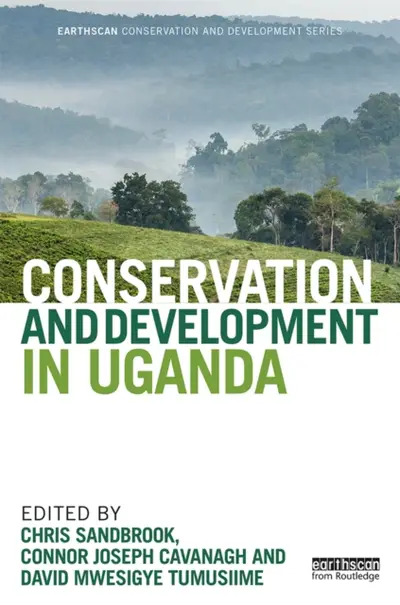
Conservation and Development in Uganda
Price and availability
$63.99
Available in: Andorra, Austria, Australia, Belgium, Bulgaria, Canada, Switzerland, Cyprus, Czechia, Germany, Denmark, Estonia, Spain, Finland, France, United Kingdom, Guernsey, Greece, Croatia, Hungary, Ireland, Isle of Man, Iceland, Italy, Jersey, Japan, Liechtenstein, Lithuania, Luxembourg, Latvia, Monaco, Malta, Netherlands, Norway, Poland, Portugal, Romania, Sweden, Slovenia, Slovakia, San Marino, United States, Vatican City, South Africa
Stores: US, UK, Canada, EU, Australia.
Sign in to buyThe price is re-checked by the server before payment.
For personal use under the eBook licence.
- Format
- DRM
- Not stated by the publisher
- Language
- English
- Publisher
- Taylor & Francis
- Published
- 21 September 2018
- ISBN
- 9781351779357
- Subjects
- Uganda, Development economics & emerging economies, Applied ecology, Conservation of the environment, Uganda, Development studies, Environmental policy and protocols, Conservation of wildlife and habitats
About this book
Uganda has extensive protected areas and iconic wildlife (including mountain gorillas), which exist within a complex social and political environment. In recent years Uganda has been seen as a test bed and model case study for numerous and varied approaches to address complex and connected conservation and development challenges. This volume reviews and assesses these initiatives, collecting new research and analyses both from emerging scholars and well-established academics in Uganda and around the globe. Approaches covered range from community-based conservation to the more recent proliferation of neoliberalised interventions based on markets and payments for ecosystem services. Drawing on insights from political ecology, human geography, institutional economics, and environmental science, the authors explore the challenges of operationalising truly sustainable forms of development in a country whose recent history is characterised by a highly volatile governance and development context. They highlight the stakes for vulnerable human populations in relation to of large and growing socioeconomic inequalities, as well as for Uganda's rich, unique, and globally significant biodiversity. They illustrate the conflicts that occur between competing claims of conservation, agriculture, tourism, and the energy and mining industries. Crucially, the book draws out lessons that can be learned from the Ugandan experience for conservation and development practitioners and scholars around the world.
Bibliographic data © Gardners Books Ltd.