PDF · English
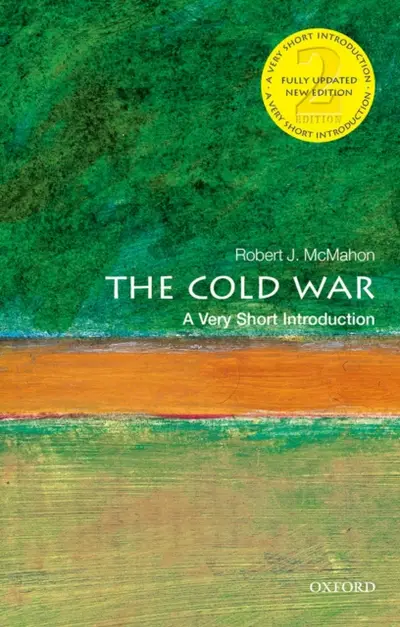
Cold War
A Very Short Introduction
Price and availability
$10.99
Available in: Andorra, Austria, Australia, Belgium, Bulgaria, Canada, Switzerland, Cyprus, Czechia, Germany, Denmark, Estonia, Spain, Finland, France, United Kingdom, Guernsey, Greece, Croatia, Hungary, Ireland, Isle of Man, Iceland, Italy, Jersey, Japan, Liechtenstein, Lithuania, Luxembourg, Latvia, Monaco, Malta, Netherlands, Norway, Poland, Portugal, Romania, Sweden, Slovenia, Slovakia, San Marino, United States, Vatican City, South Africa
Stores: US, UK, Canada, EU, Australia.
Sign in to buyThe price is re-checked by the server before payment.
For personal use under the eBook licence.
- Format
- DRM
- Not stated by the publisher
- Language
- English
- Publisher
- Oxford University Press
- Published
- 25 February 2021
- ISBN
- 9780192603265
- Subjects
- 20th century, c 1945 to c 2000 (Post-war period), Postwar 20th century history, from c 1945 to c 2000, The Cold War, Military history, Military history: post WW2 conflicts, International relations, Battles & campaigns, International relations, Cold wars and proxy conflicts, Modern warfare, Military history: post-WW2 conflicts
About this book
Very Short Introductions: Brilliant, Sharp, Inspiring The Cold War dominated international life from the end of World War II to the fall of the Berlin Wall in 1989. But how did the conflict begin? Why did it move from its initial origins in Postwar Europe to encompass virtually every corner of the globe? And why, after lasting so long, did the war end so suddenly and unexpectedly? Robert McMahon considers these questions and more, as well as looking at the legacy of the Cold War and its impact on international relations today. The Cold War: A Very Short Introduction is a truly international history, not just of the Soviet-American struggle at its heart, but also of the waves of decolonization, revolutionary nationalism, and state formation that swept the non-Western world in the wake of World War II. McMahon places the 'Hot Wars' that cost millions of lives in Korea, Vietnam, and elsewhere within the larger framework of global superpower competition. He shows how the United States and the Soviet Union both became empires over the course of the Cold War, and argues that perceived security needs and fears shaped U.S. and Soviet decisions from the beginning--far more, in fact, than did their economic and territorial ambitions. He unpacks how these needs and fears were conditioned by the divergent cultures, ideologies, and historical experiences of the two principal contestants and their allies. Covering the years 1945-1990, this second edition uses recent scholarship and newly available documents to offer a fuller analysis of the Vietnam War, the changing global politics of the 1970s, and the end of the Cold War. ABOUT THE SERIES: The Very Short Introductions series from Oxford University Press contains hundreds of titles in almost every subject area. These pocket-sized books are the perfect way to get ahead in a new subject quickly. Our expert authors combine facts, analysis, perspective, new ideas, and enthusiasm to make interesting and challenging topics highly readable.
Bibliographic data © Gardners Books Ltd.