EPUB · English
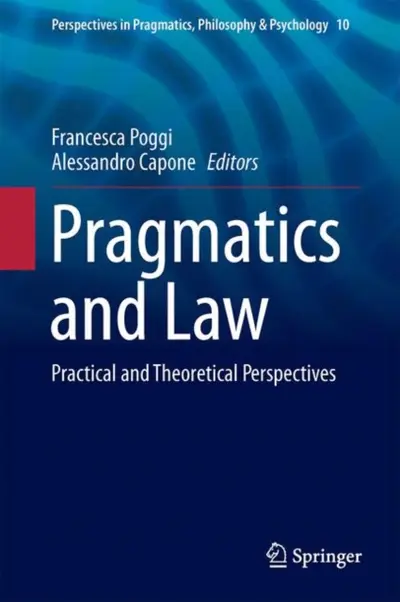
Pragmatics and Law
Practical and Theoretical Perspectives
Price and availability
$175.99
Available in: Andorra, Austria, Australia, Belgium, Bulgaria, Canada, Switzerland, Cyprus, Czechia, Germany, Denmark, Estonia, Spain, Finland, France, United Kingdom, Guernsey, Greece, Croatia, Hungary, Ireland, Isle of Man, Iceland, Italy, Jersey, Japan, Liechtenstein, Lithuania, Luxembourg, Latvia, Monaco, Malta, Netherlands, Norway, Poland, Portugal, Romania, Sweden, Slovenia, Slovakia, San Marino, United States, Vatican City, South Africa
Stores: US, UK, Canada, EU, Australia.
Sign in to buyThe price is re-checked by the server before payment.
For personal use under the eBook licence.
- Format
- EPUB
- DRM
- Not stated by the publisher
- Language
- English
- Publisher
- Springer International Publishing
- Published
- 1 December 2016
- ISBN
- 9783319446011
- Subjects
- Philosophy of language, Semantics & pragmatics, Jurisprudence & philosophy of law, Philosophy of language, Semiotics / semiology, Methods, theory and philosophy of law
About this book
This volume is the second part of a project which hosts an interdisciplinary discussion about the relationship among law and language, legal practice and ordinary conversation, legal philosophy and the linguistics sciences. An international group of authors, from cognitive science, philosophy of language and philosophy of law question about how legal theory and pragmatics can enrich each other.In particular, the first part is devoted to the analysis of how pragmatics can solve problems related to legal theory: What can pragmatics teach about the concept of law and its relationship with moral, and, in particular, about the eternal dispute between legal positivism and legal naturalism? What can pragmatics teach about the concept of law and/or legal disagreements?The second part is focused on legal adjudication: it aims to construct a pragmatic apparatus appropriate to legal trial and/or to test the tenure of the traditional pragmatics tools in the field. The authors face questions such as: Which interesting pragmatic features emerge from legal adjudication? What pragmatic theories are better suited to account for the practice of judgment or its particular aspects (such as the testimony or the binding force of legal precedents)? Which pragmatic and socio-linguistic problems are highlighted by this practice?
Bibliographic data © Gardners Books Ltd.