PDF · English
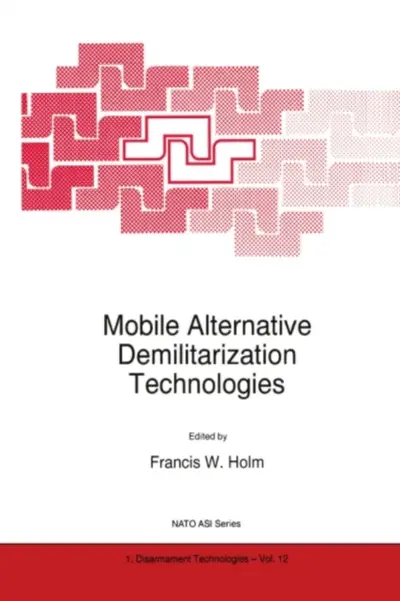
Mobile Alternative Demilitarization Technologies
Price and availability
$175.99
Available in: Andorra, Austria, Australia, Belgium, Bulgaria, Canada, Switzerland, Cyprus, Czechia, Germany, Denmark, Estonia, Spain, Finland, France, United Kingdom, Guernsey, Greece, Croatia, Hungary, Ireland, Isle of Man, Iceland, Italy, Jersey, Japan, Liechtenstein, Lithuania, Luxembourg, Latvia, Monaco, Malta, Netherlands, Norway, Poland, Portugal, Romania, Sweden, Slovenia, Slovakia, San Marino, United States, Vatican City, South Africa
Stores: US, UK, Canada, EU, Australia.
Sign in to buyThe price is re-checked by the server before payment.
For personal use under the eBook licence.
- Format
- DRM
- Not stated by the publisher
- Language
- English
- Publisher
- Springer Netherlands
- Published
- 6 December 2012
- ISBN
- 9789401155267
- Subjects
- Physical chemistry, Industrial chemistry, Chemical engineering, Mechanical engineering, Testing of materials, Physical chemistry, Industrial chemistry and chemical engineering, Mechanical engineering, Testing of materials
About this book
FRANCIS W. HOLM 7102 Meadow Lane, Chevy Chase, MD 20815 The North Atlantic Treaty Organization (NATO) sponsored an Advanced Research Workshop (ARW) in Prague, Czech Republic, on 1-2 July 1996, to collect and study information on mobile alternative and supplemental demilitarization technologies and to report these fmdings. The mobile, or transportable, technologies identified for assessment at the workshop are alternatives to incineration technology for destruction of munitions, chemical warfare agent, and associated materials and debris. Although the discussion focused on the treatment of metal parts and explosive or energetic material, requirements for decontamination of other materials were discussed. The mobile alternative technologies are grouped into three categories based on process bulk operating temperature: low (0-200 C), medium (200-600 C), and high (600- 3,500 C). Reaction types considered include hydrolysis, biodegradation, electrochemical oxidation, gas-phase high-temperature reduction, stearn reforming, gasification, sulfur reactions, solvated electron chemistry, sodium reactions, supercritical water oxidation, wet air oxidation, and plasma torch technology. These categories represent a broad spectrum of processes, some of which have been studied only in the laboratory and some of which are in commercial use for destruction of hazardous and toxic wastes. Some technologies have been developed and used for specific commercial applications; however, in all cases, research, development, test, and evaluation (RDT &E) is necessary to assure that each technology application is effective for destroying chemical warfare materiel.
Bibliographic data © Gardners Books Ltd.