PDF · English
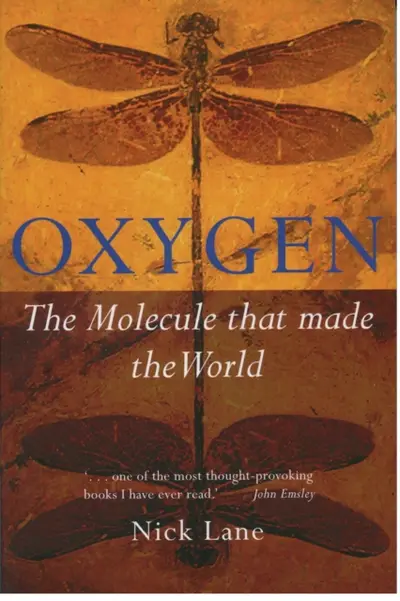
Oxygen
The molecule that made the world
- Science & mathematics
- Nature, environment & geography
- Medicine & health
- Personal development & relationships
Price and availability
$16.99
Available in: Andorra, Austria, Australia, Belgium, Bulgaria, Canada, Switzerland, Cyprus, Czechia, Germany, Denmark, Estonia, Spain, Finland, France, United Kingdom, Guernsey, Greece, Croatia, Hungary, Ireland, Isle of Man, Iceland, Italy, Jersey, Japan, Liechtenstein, Lithuania, Luxembourg, Latvia, Monaco, Malta, Netherlands, Norway, Poland, Portugal, Romania, Sweden, Slovenia, Slovakia, San Marino, United States, Vatican City, South Africa
Stores: US, UK, Canada, EU, Australia.
Sign in to buyThe price is re-checked by the server before payment.
For personal use under the eBook licence.
- Format
- DRM
- Not stated by the publisher
- Language
- English
- Publisher
- Oxford University Press
- Published
- 26 September 2002
- ISBN
- 9780191639074
- Subjects
- Maturation & ageing, Popular science, Chemistry, Biology, life sciences, Evolution, Earth sciences, Popular medicine & health, Maturation and ageing, Popular science, Chemistry, Biology, life sciences, Popular medicine and health
About this book
Oxygen has had extraordinary effects on life. Three hundred million years ago, in Carboniferous times, dragonflies grew as big as seagulls, with wingspans ofnearly a metre. Researchers claim they could have flown only if the air had contained more oxygen than today -probably as much as 35 per cent. Giant spiders, tree-ferns, marine rock formations and fossil charcoalsall tell the same story. High oxygen levels may also explain the global firestorm that contributed to thedemise of the dinosaurs after the asteroid impact. The strange and profound effects that oxygen has had on the evolution of life pose a riddle, which this booksets out to answer. Oxygen is a toxic gas. Divers breathing pure oxygen at depth suffer from convulsionsand lung injury. Fruit flies raised at twice normal atmospheric levels of oxygen live half as long as theirsiblings. Reactive forms of oxygen, known as free radicals, are thought to cause ageing in people. Yet ifatmospheric oxygen reached 35 per cent in the Carboniferous, why did it promote exuberant growth,instead of rapid ageing and death? Oxygen takes the reader on an enthralling journey, as gripping as a thriller, as it unravels the unexpectedways in which oxygen spurred the evolution of life and death. The book explains far more than the size ofancient insects: it shows how oxygen underpins the origin of biological complexity, the birth of photosynthesis, the sudden evolution of animals, the need for two sexes, the accelerated ageing of cloned animals like Dolly the sheep, and the surprisingly long lives of bats and birds. Drawing on this grand evolutionary canvas, Oxygen offers fresh perspectives on our own lives and deaths,explaining modern killer diseases, why we age, and what we can do about it. Advancing revelatory new ideas,following chains of evidence, the book ranges through many disciplines, from environmental sciences tomolecular medicine. The result is a captivating vision of contemporary science and a humane synthesis of ourplace in nature. This remarkable book will redefine the way we think about the world.
Bibliographic data © Gardners Books Ltd.