PDF · English
Product Design for Modularity
Price and availability
$215.99
Available in: Andorra, Austria, Australia, Belgium, Bulgaria, Canada, Switzerland, Cyprus, Czechia, Germany, Denmark, Estonia, Spain, Finland, France, United Kingdom, Guernsey, Greece, Croatia, Hungary, Ireland, Isle of Man, Iceland, Italy, Jersey, Japan, Liechtenstein, Lithuania, Luxembourg, Latvia, Monaco, Malta, Netherlands, Norway, Poland, Portugal, Romania, Sweden, Slovenia, Slovakia, San Marino, United States, Vatican City, South Africa
Stores: US, UK, Canada, EU, Australia.
Sign in to buyThe price is re-checked by the server before payment.
For personal use under the eBook licence.
- Format
- DRM
- Not stated by the publisher
- Language
- English
- Publisher
- Springer US
- Published
- 17 April 2013
- ISBN
- 9781475735819
- Subjects
- Industrial / commercial art & design, Management decision making, Management of specific areas, Operational research, Industrial chemistry & manufacturing technologies, Industrial chemistry, Production engineering, Design, Industrial and commercial arts, illustration, Management decision making, Management of specific areas, Operational research, Industrial chemistry and chemical engineering, Production and industrial engineering
About this book
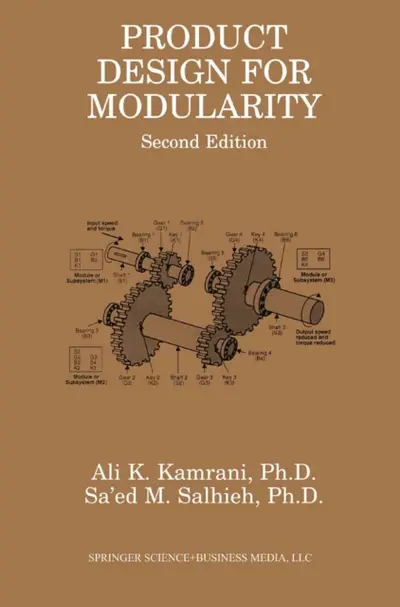
Modular products are products that fulfill various overall functions through the combination of distinct building blocks or modules, in the sense that the overall function performed by the product can be divided into sub-functions that can be implemented by different modules or components. An important aspect of modular products is the creation of a basic core unit to which different components (modules) can be fitted, thus enabling a variety of versions of the same module to be produced. The core should have sufficient capacity to cope with all expected variations in performance and usage. Components used in a modular product must have features that enable them to be coupled together to form a complex product. Modularity will promote: reduction in product development time; customization and upgrades; cost efficiencies due to amortization; quality design standardization; and reduction in order lead time. The purpose of this book is to develop a structured approach to the design of products using the concept of modularity, assembly, and manufacturability. The book has proposed and developed a structured and systematic approach to product and systems design using the modularity concept. Mathematical and genetic algorithm models are developed to support the developed methodology.
Bibliographic data © Gardners Books Ltd.