PDF · English
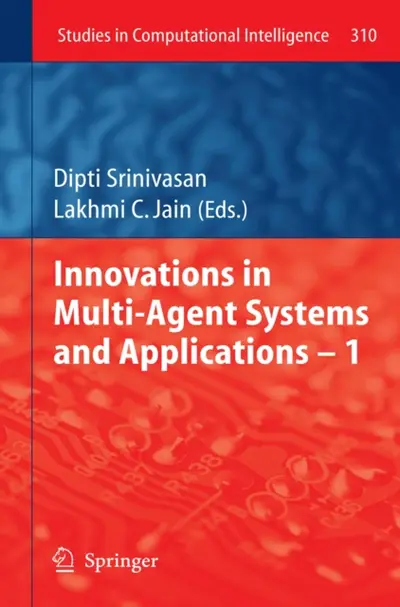
Innovations in Multi-Agent Systems and Application - 1
Price and availability
$175.99
Available in: Andorra, Austria, Australia, Belgium, Bulgaria, Canada, Switzerland, Cyprus, Czechia, Germany, Denmark, Estonia, Spain, Finland, France, United Kingdom, Guernsey, Greece, Croatia, Hungary, Ireland, Isle of Man, Iceland, Italy, Jersey, Japan, Liechtenstein, Lithuania, Luxembourg, Latvia, Monaco, Malta, Netherlands, Norway, Poland, Portugal, Romania, Sweden, Slovenia, Slovakia, San Marino, United States, Vatican City, South Africa
Stores: US, UK, Canada, EU, Australia.
Sign in to buyThe price is re-checked by the server before payment.
For personal use under the eBook licence.
- Format
- DRM
- Not stated by the publisher
- Language
- English
- Publisher
- Springer Berlin Heidelberg
- Published
- 17 July 2010
- ISBN
- 9783642144356
- Subjects
- Applied mathematics, Engineering: general, Maths for engineers, Artificial intelligence, Maths for engineers, Artificial intelligence (AI)
About this book
In today's world, the increasing requirement for emulating the behavior of real-world applications for achieving effective management and control has necessitated the usage of advanced computational techniques. Computational intelligence-based techniques that combine a variety of problem solvers are becoming increasingly pervasive. The ability of these methods to adapt to the dynamically changing environment and learn in an online manner has increased their usefulness in simulating intelligent behaviors as observed in humans. These intelligent systems are able to handle the stochastic and uncertain nature of the real-world problems. Application domains requiring interaction of people or organizations with different, even possibly conflicting goals and proprietary information handling are growing exponentially. To efficiently handle these types of complex interactions, distributed problem solving systems like multiagent systems have become a necessity. The rapid advancements in network communication technologies have provided the platform for successful implementation of such intelligent agent-based problem solvers. An agent can be viewed as a self-contained, concurrently executing thread of control that encapsulates some state and communicates with its environment, and possibly other agents via message passing. Agent-based systems offer advantages when independently developed components must interoperate in a heterogenous environment. Such agent-based systems are increasingly being applied in a wide range of areas including telecommunications, Business process modeling, computer games, distributed system control and robot systems.
Bibliographic data © Gardners Books Ltd.