PDF · English
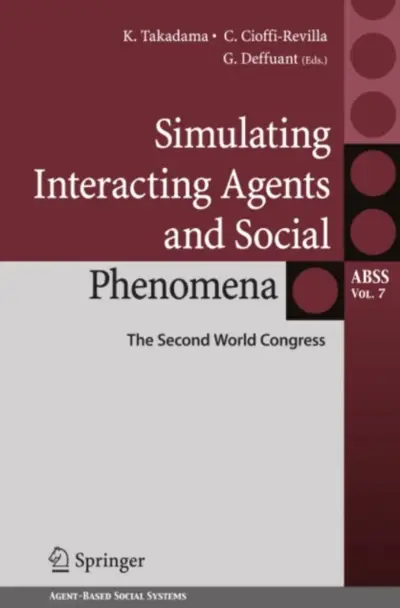
Simulating Interacting Agents and Social Phenomena
The Second World Congress
- Society & social sciences
- Economics, business & finance
- Science & mathematics
- Technology & engineering
- Computing & IT
- Reference
Price and availability
$175.99
Available in: Andorra, Austria, Australia, Belgium, Bulgaria, Canada, Switzerland, Cyprus, Czechia, Germany, Denmark, Estonia, Spain, Finland, France, United Kingdom, Guernsey, Greece, Croatia, Hungary, Ireland, Isle of Man, Iceland, Italy, Jersey, Japan, Liechtenstein, Lithuania, Luxembourg, Latvia, Monaco, Malta, Netherlands, Norway, Poland, Portugal, Romania, Sweden, Slovenia, Slovakia, San Marino, United States, Vatican City, South Africa
Stores: US, UK, Canada, EU, Australia.
Sign in to buyThe price is re-checked by the server before payment.
For personal use under the eBook licence.
- Format
- DRM
- Not stated by the publisher
- Language
- English
- Publisher
- Springer Japan
- Published
- 2 September 2010
- ISBN
- 9784431997818
- Subjects
- Cybernetics & systems theory, Social interaction, Sociology, Econometrics, Game theory, Engineering: general, Business applications, Cybernetics and systems theory, Sociology, Economic theory and philosophy, Maths for engineers, Computer applications in the social and behavioural sciences
About this book
Agent-based modeling and social simulation have emerged as an interdisciplinary area of social science that includes computational economics, organizational science, social dynamics, and complex systems. This area contributes to enriching our understanding of the fundamental processes of social phenomena caused by complex interactions among agents. Bringing together diverse approaches to social simulation and research agendas, this book presents a unique collection of contributions from the Second World Congress on Social Simulation, held in 2008 at George Mason University in Washington DC, USA. This book in particular includes articles on norms, diffusion, social networks, economy, markets and organizations, computational modeling, and programming environments, providing new hypotheses and theories, new simulation experiments compared with various data sets, and new methods for model design and development. These works emerged from a global and interdisciplinary scientific community of the three regional scientific associations for social simulation: the North American Association for Computational Social and Organizational Science (NAACSOS; now the Computational Social Science Society, CSSS), the European Social Simulation Association (ESSA), and the Pacific Asian Association for Agent-bBased Approach in Social Systems Sciences (PAAA).
Bibliographic data © Gardners Books Ltd.