PDF · English
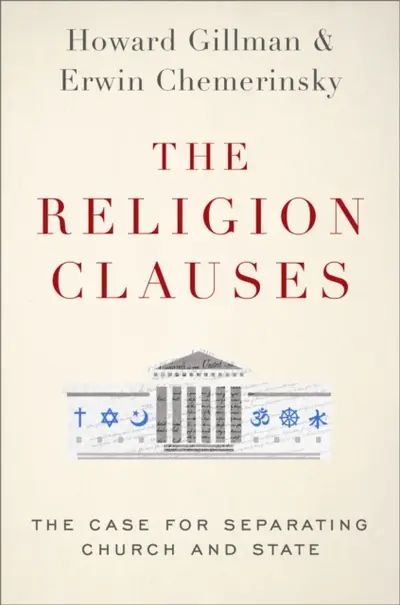
Religion Clauses
The Case for Separating Church and State
Price and availability
$20.99
Available in: Andorra, Austria, Australia, Belgium, Bulgaria, Canada, Switzerland, Cyprus, Czechia, Germany, Denmark, Estonia, Spain, Finland, France, United Kingdom, Guernsey, Greece, Croatia, Hungary, Ireland, Isle of Man, Iceland, Italy, Jersey, Japan, Liechtenstein, Lithuania, Luxembourg, Latvia, Monaco, Malta, Netherlands, Norway, Poland, Portugal, Romania, Sweden, Slovenia, Slovakia, San Marino, United States, Vatican City, South Africa
Stores: US, UK, Canada, EU, Australia.
Sign in to buyThe price is re-checked by the server before payment.
For personal use under the eBook licence.
- Format
- DRM
- Not stated by the publisher
- Language
- English
- Publisher
- Oxford University Press
- Published
- 30 July 2020
- ISBN
- 9780190699741
- Subjects
- USA, Law, Systems of law, Law & society, Constitutional & administrative law, United States of America, USA, Law, Systems of law, Law and society, sociology of law, Constitutional and administrative law: general
About this book
Throughout American history, views on the proper relationship between the state and religion have been deeply divided. And, with recent changes in the composition of the Supreme Court, First Amendment law concerning religion is likely to change dramatically in the years ahead. In The Religion Clauses, Erwin Chemerinsky and Howard Gillman, two of America's leading constitutional scholars, begin by explaining how freedom of religion is enshrined in the First Amendment through two provisions. They defend a robust view of both clauses and work from the premise that that the establishment clause is best understood, in the words of Thomas Jefferson, as creating a wall separating church and state. After examining all the major approaches to the meaning of the Constitution's religion clauses, they contend that the best approaches are for the government to be strictly secular and for there to be no special exemptions for religious people from neutral and general laws that others must obey. In an America that is only becoming more diverse with respect to religion, this is not only the fairest approach, but the one most in tune with what the First Amendment actually prescribes. Both a pithy primer on the meaning of the religion clauses and a broad-ranging indictment of the Court's misinterpretation of them in recent years, The Religion Clauses shows how a separationist approach is most consistent with the concerns of the founders who drafted the Constitution and with the needs of a religiously pluralistic society in the 21st century.
Bibliographic data © Gardners Books Ltd.