PDF · English
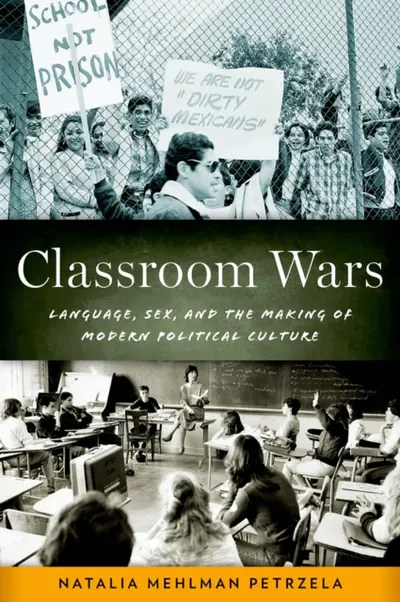
Classroom Wars
Language, Sex, and the Making of Modern Political Culture
Price and availability
$18.99
Available in: Andorra, Austria, Australia, Belgium, Bulgaria, Canada, Switzerland, Cyprus, Czechia, Germany, Denmark, Estonia, Spain, Finland, France, United Kingdom, Guernsey, Greece, Croatia, Hungary, Ireland, Isle of Man, Iceland, Italy, Jersey, Japan, Liechtenstein, Lithuania, Luxembourg, Latvia, Monaco, Malta, Netherlands, Norway, Poland, Portugal, Romania, Sweden, Slovenia, Slovakia, San Marino, United States, Vatican City, South Africa
Stores: US, UK, Canada, EU, Australia.
Sign in to buyThe price is re-checked by the server before payment.
For personal use under the eBook licence.
- Format
- DRM
- Not stated by the publisher
- Language
- English
- Publisher
- Oxford University Press
- Published
- 3 March 2015
- ISBN
- 9780199358465
- Subjects
- USA, 20th century, History of the Americas, 20th century history: c 1900 to c 2000, Gender studies, gender groups, Ethnic studies, Schools, Politics & government, United States of America, USA, 3MP, JBSF, JBSL, Schools and pre-schools, Politics and government, NH, NHK
About this book
The schoolhouse has long been a crucible in the construction and contestation of the political concept of "e;family values."e; Through Spanish-bilingual and sex education, moderates and conservatives in California came to define the family as a politicized and racialized site in the late 1960s and 1970s. Sex education became a vital arena in the culture wars as cultural conservatives imagined the family as imperiled by morally lax progressives and liberals who advocated for these programs attempted to manage the onslaught of sexual explicitness in broader culture. Many moderates, however, doubted the propriety of addressing such sensitive issues outside the home. Bilingual education, meanwhile, was condemned as a symbol of wasteful federal spending on ethically questionable curricula and an intrusion on local prerogative. Spanish-language bilingual-bicultural programs may seem less relevant to the politics of family, but many Latino parents and students attempted to assert their authority, against great resistance, in impassioned demands to incorporate their cultural and linguistic heritage into the classroom. Both types of educational programs, in their successful implementation and in the reaction they inspired, highlight the rightward turn and enduring progressivism in postwar American political culture. In Classroom Wars, Natalia Mehlman Petrzela charts how a state and a citizenry deeply committed to public education as an engine of civic and moral education navigated the massive changes brought about by the 1960s, including the sexual revolution, school desegregation, and a dramatic increase in Latino immigration. She traces the mounting tensions over educational progressivism, cultural and moral decay, and fiscal improvidence, using sources ranging from policy documents to student newspapers, from course evaluations to oral histories. Petrzela reveals how a growing number of Americans fused values about family, personal, and civic morality, which galvanized a powerful politics that engaged many Californians and, ultimately, many Americans. In doing so, they blurred the distinction between public and private and inspired some of the fiercest classroom wars in American history. Taking readers from the cultures of Orange County mega-churches to Berkeley coffeehouses, Natalia Mehlman Petrzela's history of these classroom controversies sheds light on the bitterness of the battles over diversity we continue to wage today and their influence on schools and society nationwide.
Bibliographic data © Gardners Books Ltd.