PDF · English
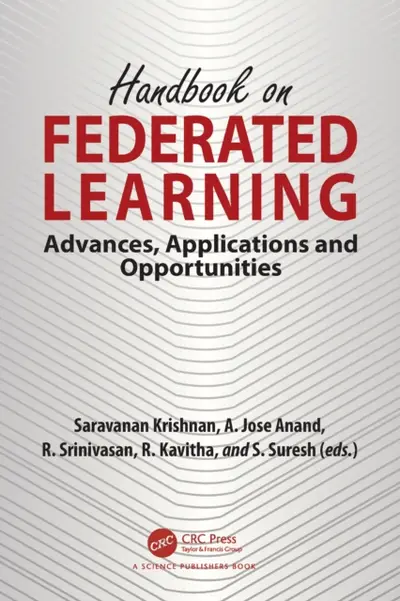
Handbook on Federated Learning
Advances, Applications and Opportunities
Price and availability
$75.99
Available in: Andorra, Austria, Australia, Belgium, Bulgaria, Canada, Switzerland, Cyprus, Czechia, Germany, Denmark, Estonia, Spain, Finland, France, United Kingdom, Guernsey, Greece, Croatia, Hungary, Ireland, Isle of Man, Iceland, Italy, Jersey, Japan, Liechtenstein, Lithuania, Luxembourg, Latvia, Monaco, Malta, Netherlands, Norway, Poland, Portugal, Romania, Sweden, Slovenia, Slovakia, San Marino, United States, Vatican City, South Africa
Stores: US, UK, Canada, EU, Australia.
Sign in to buyThe price is re-checked by the server before payment.
For personal use under the eBook licence.
- Format
- DRM
- Not stated by the publisher
- Language
- English
- Publisher
- CRC Press
- Published
- 15 December 2023
- ISBN
- 9781003837503
- Subjects
- Mathematics, Probability & statistics, Biology, life sciences, Electrical engineering, Automatic control engineering, Legal aspects of IT, Computer security, Computer networking & communications, Computer science, Systems analysis & design, Computer architecture & logic design, Artificial intelligence, Privacy and data protection, Cloud computing, Machine learning
About this book
Mobile, wearable, and self-driving telephones are just a few examples of modern distributed networks that generate enormous amount of information every day. Due to the growing computing capacity of these devices as well as concerns over the transfer of private information, it has become important to process the part of the data locally by moving the learning methods and computing to the border of devices. Federated learning has developed as a model of education in these situations. Federated learning (FL) is an expert form of decentralized machine learning (ML). It is essential in areas like privacy, large-scale machine education and distribution. It is also based on the current stage of ICT and new hardware technology and is the next generation of artificial intelligence (AI). In FL, central ML model is built with all the data available in a centralised environment in the traditional machine learning. It works without problems when the predictions can be served by a central server. Users require fast responses in mobile computing, but the model processing happens at the sight of the server, thus taking too long. The model can be placed in the end-user device, but continuous learning is a challenge to overcome, as models are programmed in a complete dataset and the end-user device lacks access to the entire data package. Another challenge with traditional machine learning is that user data is aggregated at a central location where it violates local privacy policies laws and make the data more vulnerable to data violation. This book provides a comprehensive approach in federated learning for various aspects.
Bibliographic data © Gardners Books Ltd.