EPUB · English
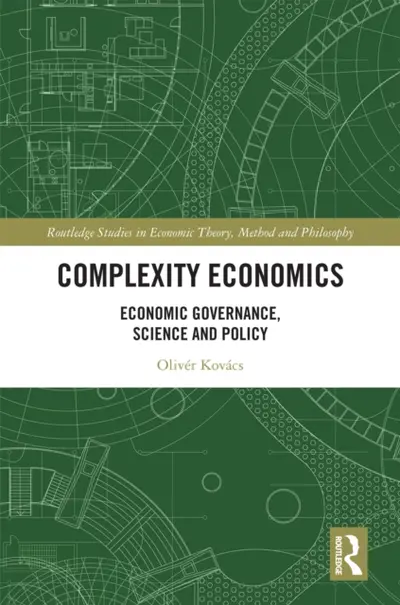
Complexity Economics
Economic Governance, Science and Policy
Price and availability
$63.99
Available in: Andorra, Austria, Australia, Belgium, Bulgaria, Canada, Switzerland, Cyprus, Czechia, Germany, Denmark, Estonia, Spain, Finland, France, United Kingdom, Guernsey, Greece, Croatia, Hungary, Ireland, Isle of Man, Iceland, Italy, Jersey, Japan, Liechtenstein, Lithuania, Luxembourg, Latvia, Monaco, Malta, Netherlands, Norway, Poland, Portugal, Romania, Sweden, Slovenia, Slovakia, San Marino, United States, Vatican City, South Africa
Stores: US, UK, Canada, EU, Australia.
Sign in to buyThe price is re-checked by the server before payment.
For personal use under the eBook licence.
- Format
- EPUB
- DRM
- Not stated by the publisher
- Language
- English
- Publisher
- Taylor & Francis
- Published
- 15 July 2022
- ISBN
- 9781000610246
- Subjects
- Economics, Economic theory & philosophy, Political economy, Public administration / Public policy, Economic theory and philosophy, Economic systems and structures
About this book
Our socio-economic innovation ecosystem is riddled with ever-increasing complexity, as we are faced with more frequent and intense shocks, such as COVID-19. Unfortunately, addressing complexity requires a different kind of economic governance. There is increasing pressure on economics to not only going beyond its traditional mainstream boundaries but also to tackle real-world problems, such as fostering structural change, enhancing sustained growth, promoting inclusive development in the era of the digital economy, and boosting green growth, while addressing the divide between the financial sector and the real economy. This book demonstrates how to apply complexity science to economics in an effective and instructive way, in the interest of life-enhancing policies. The book revolves around the non-negligible problem of why economics, to date, seems to be inadequate in guiding economic governance to navigate through real and ever-intensifying complex socio-economic and environmental challenges. With its interdisciplinary approach, the book scans the nuanced nexus between complexity and economics by incorporating, as well as transcending, the state-of-the-art literature. It identifies ways to trigger opportunities for behavioural change in the economic profession with respect to how and what to teach, introducing and developing further complexity economics taking into account the configuration of its main principles and outlining the silhouette of next-generation economic governance. The book deciphers recommendations for economic theory, practice, education and economic governance. It will be of interest to students, scholars, academics, think-tank researchers and economic policy practitioners at the national and/or supranational levels.
Bibliographic data © Gardners Books Ltd.