PDF · English
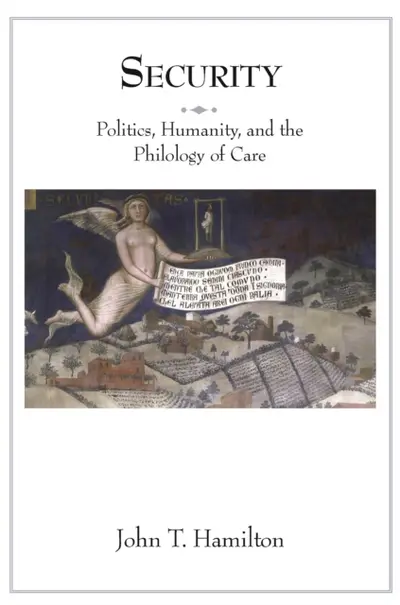
Security
Politics, Humanity, and the Philology of Care
Price and availability
$37.99
Available in: Andorra, Austria, Australia, Belgium, Bulgaria, Canada, Switzerland, Cyprus, Czechia, Germany, Denmark, Estonia, Spain, Finland, France, United Kingdom, Guernsey, Greece, Croatia, Hungary, Ireland, Isle of Man, Iceland, Italy, Jersey, Japan, Liechtenstein, Lithuania, Luxembourg, Latvia, Monaco, Malta, Netherlands, Norway, Poland, Portugal, Romania, Sweden, Slovenia, Slovakia, San Marino, United States, Vatican City, South Africa
Stores: US, UK, Canada, EU, Australia.
Sign in to buyThe price is re-checked by the server before payment.
For personal use under the eBook licence.
- Format
- DRM
- Not stated by the publisher
- Language
- English
- Publisher
- Princeton University Press
- Published
- 21 June 2013
- ISBN
- 9781400846474
- Subjects
- Semantics, discourse analysis, etc, Social & political philosophy, Semantics, discourse analysis, stylistics, Literature: history and criticism
About this book
From national security and social security to homeland and cyber-security, "e;security"e; has become one of the most overused words in culture and politics today. Yet it also remains one of the most undefined. What exactly are we talking about when we talk about security? In this original and timely book, John Hamilton examines the discursive versatility and semantic vagueness of security both in current and historical usage. Adopting a philological approach, he explores the fundamental ambiguity of this word, which denotes the removal of "e;concern"e; or "e;care"e; and therefore implies a condition that is either carefree or careless. Spanning texts from ancient Greek poetry to Roman Stoicism, from Augustine and Luther to Machiavelli and Hobbes, from Kant and Nietzsche to Heidegger and Carl Schmitt, Hamilton analyzes formulations of security that involve both safety and negligence, confidence and complacency, certitude and ignorance. Does security instill more fear than it assuages? Is a security purchased with freedom or human rights morally viable? How do security projects inform our expectations, desires, and anxieties? And how does the will to security relate to human finitude? Although the book makes clear that security has always been a major preoccupation of humanity, it also suggests that contemporary panics about security and the related desire to achieve perfect safety carry their own very significant risks.
Bibliographic data © Gardners Books Ltd.