EPUB · English
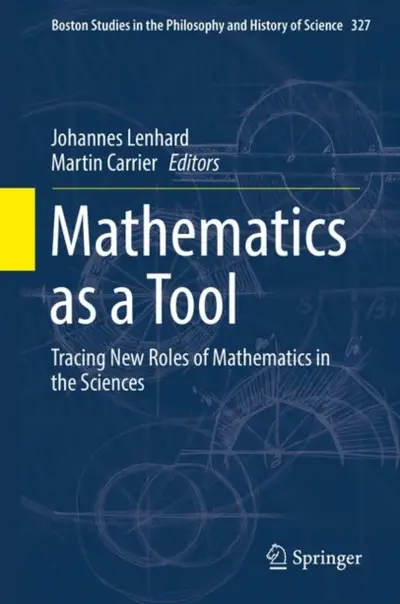
Mathematics as a Tool
Tracing New Roles of Mathematics in the Sciences
Price and availability
$148.99
Available in: Andorra, Austria, Australia, Belgium, Bulgaria, Canada, Switzerland, Cyprus, Czechia, Germany, Denmark, Estonia, Spain, Finland, France, United Kingdom, Guernsey, Greece, Croatia, Hungary, Ireland, Isle of Man, Iceland, Italy, Jersey, Japan, Liechtenstein, Lithuania, Luxembourg, Latvia, Monaco, Malta, Netherlands, Norway, Poland, Portugal, Romania, Sweden, Slovenia, Slovakia, San Marino, United States, Vatican City, South Africa
Stores: US, UK, Canada, EU, Australia.
Sign in to buyThe price is re-checked by the server before payment.
For personal use under the eBook licence.
- Format
- EPUB
- DRM
- Not stated by the publisher
- Language
- English
- Publisher
- Springer International Publishing
- Published
- 4 April 2017
- ISBN
- 9783319544694
- Subjects
- Applied mathematics, History of mathematics, Philosophy of science, History of science, The environment, Environmental science, engineering & technology, Applied mathematics, History of mathematics, Philosophy of science, History of science, The environment
About this book
This book puts forward a new role for mathematics in the natural sciences. In the traditional understanding, a strong viewpoint is advocated, on the one hand, according to which mathematics is used for truthfully expressing laws of nature and thus for rendering the rational structure of the world. In a weaker understanding, many deny that these fundamental laws are of an essentially mathematical character, and suggest that mathematics is merely a convenient tool for systematizing observational knowledge. The position developed in this volume combines features of both the strong and the weak viewpoint. In accordance with the former, mathematics is assigned an active and even shaping role in the sciences, but at the same time, employing mathematics as a tool is taken to be independent from the possible mathematical structure of the objects under consideration. Hence the tool perspective is contextual rather than ontological. Furthermore, tool-use has to respect conditions like suitability, efficacy, optimality, and others. There is a spectrum of means that will normally differ in how well they serve particular purposes. The tool perspective underlines the inevitably provisional validity of mathematics: any tool can be adjusted, improved, or lose its adequacy upon changing practical conditions.
Bibliographic data © Gardners Books Ltd.