PDF · English
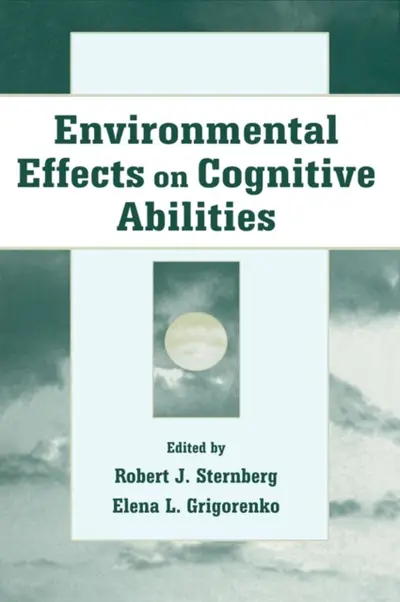
Environmental Effects on Cognitive Abilities
Price and availability
$83.99
Available in: Andorra, Austria, Australia, Belgium, Bulgaria, Canada, Switzerland, Cyprus, Czechia, Germany, Denmark, Estonia, Spain, Finland, France, United Kingdom, Guernsey, Greece, Croatia, Hungary, Ireland, Isle of Man, Iceland, Italy, Jersey, Japan, Liechtenstein, Lithuania, Luxembourg, Latvia, Monaco, Malta, Netherlands, Norway, Poland, Portugal, Romania, Sweden, Slovenia, Slovakia, San Marino, United States, Vatican City, South Africa
Stores: US, UK, Canada, EU, Australia.
Sign in to buyThe price is re-checked by the server before payment.
For personal use under the eBook licence.
- Format
- DRM
- Not stated by the publisher
- Language
- English
- Publisher
- Taylor & Francis
- Published
- 8 April 2014
- ISBN
- 9781135671181
- Subjects
- Psychology, Cognitivism, cognitive theory, Child & developmental psychology, Social, group or collective psychology, Cognition & cognitive psychology, Child, developmental and lifespan psychology, Cognition and cognitive psychology, Public health and preventive medicine
About this book
It sometimes seems that it is difficult to pick up a current newspaper or a magazine without it containing a story about some behavioral characteristic for which it has been found that a gene is responsible. Even aspects of behavior that one would feel certain are environmentally controlled are now being attributed in part to the effects of the genes. But genes never act alone: Their effects are always filtered through the environment. The goal of this volume is to discuss how the environment influences the development and the maintenance of cognitive abilities. It is a successor to the editors' 1997 volume, Intelligence, Heredity, and Environment, and a companion to their new volume, Family Environment and Intellectual Functioning: A Life-Span Perspective. Taken together, the two-volume set comprises the most comprehensive existing work on the relation between the environment and cognitive abilities. Psychologists, parents, social workers, educators, and employers are all likely to find this book of interest.
Bibliographic data © Gardners Books Ltd.