PDF · English
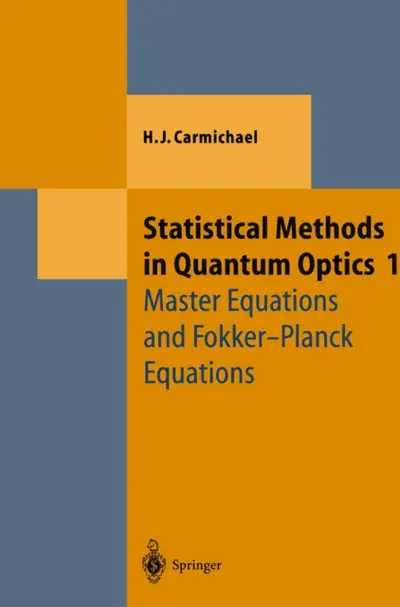
Statistical Methods in Quantum Optics 1
Master Equations and Fokker-Planck Equations
Price and availability
$74.99
Available in: Andorra, Austria, Australia, Belgium, Bulgaria, Canada, Switzerland, Cyprus, Czechia, Germany, Denmark, Estonia, Spain, Finland, France, United Kingdom, Guernsey, Greece, Croatia, Hungary, Ireland, Isle of Man, Iceland, Italy, Jersey, Japan, Liechtenstein, Lithuania, Luxembourg, Latvia, Monaco, Malta, Netherlands, Norway, Poland, Portugal, Romania, Sweden, Slovenia, Slovakia, San Marino, United States, Vatican City, South Africa
Stores: US, UK, Canada, EU, Australia.
Sign in to buyThe price is re-checked by the server before payment.
For personal use under the eBook licence.
- Format
- DRM
- Not stated by the publisher
- Language
- English
- Publisher
- Springer Berlin Heidelberg
- Published
- 17 April 2013
- ISBN
- 9783662038758
- Subjects
- Cybernetics & systems theory, Optical physics, Electricity, electromagnetism & magnetism, Quantum physics (quantum mechanics & quantum field theory), Statistical physics, Mathematical physics, Laser technology & holography, Cybernetics and systems theory, Optical physics, Laser physics, Electricity, electromagnetism and magnetism, Particle and high-energy physics, Quantum physics (quantum mechanics and quantum field theory), Mathematical / Computational / Theoretical physics
About this book
As a graduate student working in quantum optics I encountered the question that might be taken as the theme of this book. The question definitely arose at that time though it was not yet very clearly defined; there was simply some deep irritation caused by the work I was doing, something quite fundamental I did not understand. Of course, so many things are not understood when one is a graduate student. However, my nagging question was not a technical issue, not merely a mathematical concept that was difficult to grasp. It was a sense that certain elementary notions that are accepted as starting points for work in quantum optics somehow had no fundamental foundation, no identifiable root. My inclination was to mine physics vertically, and here was a subject whose tunnels were dug horizontally. There were branches, certainly, going up and going down. Nonetheless, something major in the downwards direction was missing-at least in my understanding; no doubt others understood the connections downwards very well. In retrospect I can identify the irritation. Quantum optics deals primarily with dynamics, quantum dynamics, and in doing so makes extensive use of words like "e;quantum fluctuations"e; and "e;quantum noise. "e; The words seem harmless enough. Surely the ideas behind them are quite clear; after all, quantum mechanics is a statistical theory, and in its dynamical aspects it is therefore a theory of fluctuations. But there was my problem. Nothing in Schrodinger's equation fluctuates.
Bibliographic data © Gardners Books Ltd.