EPUB · English
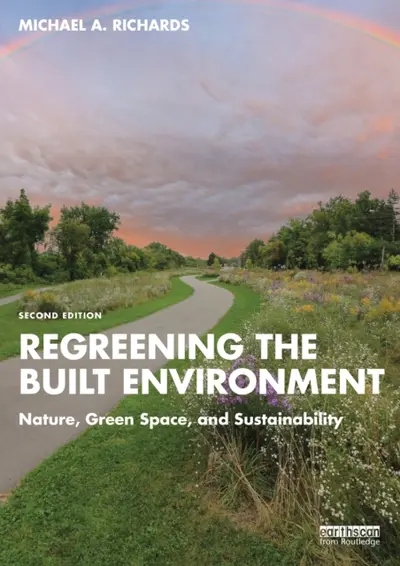
Regreening the Built Environment
Nature, Green Space, and Sustainability
Price and availability
$59.99
Available in: Andorra, Austria, Australia, Belgium, Bulgaria, Canada, Switzerland, Cyprus, Czechia, Germany, Denmark, Estonia, Spain, Finland, France, United Kingdom, Guernsey, Greece, Croatia, Hungary, Ireland, Isle of Man, Iceland, Italy, Jersey, Japan, Liechtenstein, Lithuania, Luxembourg, Latvia, Monaco, Malta, Netherlands, Norway, Poland, Portugal, Romania, Sweden, Slovenia, Slovakia, San Marino, United States, Vatican City, South Africa
Stores: US, UK, Canada, EU, Australia.
Sign in to buyThe price is re-checked by the server before payment.
For personal use under the eBook licence.
- Format
- EPUB
- DRM
- Not stated by the publisher
- Language
- English
- Publisher
- Taylor & Francis
- Published
- 18 September 2024
- ISBN
- 9781040126868
- Subjects
- City & town planning - architectural aspects, Sustainability, Urban & municipal planning, Transport planning & policy, Environmental science, engineering & technology, Environmentally-friendly and sustainable architecture and design, Climate change, Urban and municipal planning and policy
About this book
Now in its second volume, Regreening the Built Environment provides an overview of physical and social environmental challenges that the planet is facing and presents solutions that restore ecological processes, reclaim open space, foster social equity, and facilitate a green economy.Healing the planet requires a combination of strategies networked across multiple scales of development, including buildings, sites, communities, and regions. Case studies from a range of locations in the United States, Denmark, Vietnam, Germany, South Korea, Switzerland, France, and the United Kingdom, among others, demonstrate how existing gray infrastructure can be retrofitted with green infrastructure and low-impact development techniques. From this, the author shows how a building can be designed that creates greenspace or generates energy; likewise, a roadway can be a parkway, an alley can be a wildlife corridor, and a parking surface can be a garden. This new edition also includes case studies that have successfully reconnected communities that were fragmented by unjust planning practices and irresponsible patterns of development, resilient design solutions in response to natural disasters, passive design strategies that can make interior spaces more efficient and healthier, and expanded discussions on capturing carbon, renewable energy, agriculture, waste, public transit, and adaptive reuse, including innovative ideas on how to reimagine the shopping mall in the era of e-commerce.The strategies presented in this book will stimulate discussions within the design profession and will be of great interest to students and practitioners of environmental studies, architecture, landscape architecture, and urban design.
Bibliographic data © Gardners Books Ltd.