EPUB · English
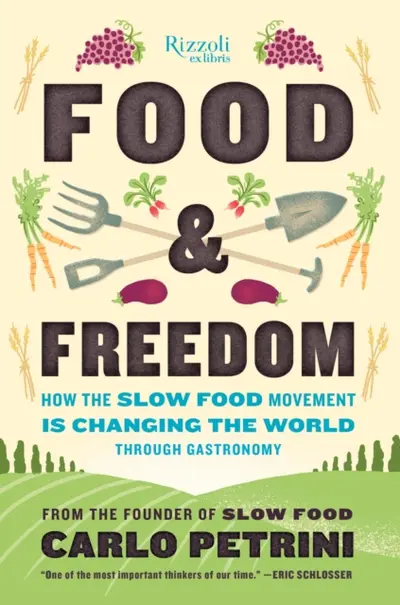
Food & Freedom
How the Slow Food Movement Is Changing the World Through Gastronomy
- Society & social sciences
- Nature, environment & geography
- Medicine & health
- Personal development & relationships
- Lifestyle, food & travel
Price and availability
$29.99
Available in: Andorra, Austria, Australia, Belgium, Bulgaria, Canada, Switzerland, Cyprus, Czechia, Germany, Denmark, Estonia, Spain, Finland, France, United Kingdom, Guernsey, Greece, Croatia, Hungary, Ireland, Isle of Man, Iceland, Italy, Jersey, Japan, Liechtenstein, Lithuania, Luxembourg, Latvia, Monaco, Malta, Netherlands, Norway, Poland, Portugal, Romania, Sweden, Slovenia, Slovakia, San Marino, United States, Vatican City, South Africa
Stores: US, UK, Canada, EU, Australia.
Sign in to buyThe price is re-checked by the server before payment.
For personal use under the eBook licence.
- Format
- EPUB
- DRM
- Not stated by the publisher
- Language
- English
- Publisher
- Rizzoli
- Published
- 1 September 2015
- ISBN
- 9780847847211
- Subjects
- Food & society, Food security & supply, Popular medicine & health, General cookery & recipes, JBCC4, Food security and supply, Popular medicine and health, General cookery and recipes
About this book
Inspiring the global fight to revolutionize the way food is grown, distributed, and eaten. In the almost thirty years since Carlo Petrini began the Slow Food organization, he has been constantly engaged in the fight for food justice. Beginning first in his native Italy and then expanding all over the world, the movement has created a powerful force for change.   The essential argument of this book is that food is an avenue towards freedom. This uplifting and humanistic message is straightforward: if people can feed themselves, they can be free. In other words, if people can regain control over access to their food—how it is produced, by whom, and how it is distributed—then that can lead to a greater empowerment in all channels of life. Whether in the Amazon jungle talking with tribal elders or on rice paddies in rural Indonesia, the author engages the reader through the excitement of his journeys and the passion of his mission.   Here, Petrini reports upon some of the success stories that he has observed firsthand. From Chiapas to Puglia, Morocco to North Carolina, he has witnessed the many ways different peoples have dealt with food problems. This book allows us to learn from these case studies and lays out models for the future.
Bibliographic data © Gardners Books Ltd.