PDF · English
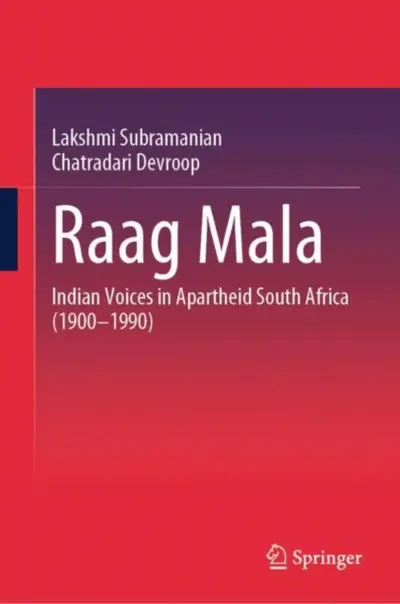
Raag Mala
Indian Voices in Apartheid South Africa (1900-1990)
Price and availability
$148.99
Available in: Andorra, Austria, Australia, Belgium, Bulgaria, Canada, Switzerland, Cyprus, Czechia, Germany, Denmark, Estonia, Spain, Finland, France, United Kingdom, Guernsey, Greece, Croatia, Hungary, Ireland, Isle of Man, Iceland, Italy, Jersey, Japan, Liechtenstein, Lithuania, Luxembourg, Latvia, Monaco, Malta, Netherlands, Norway, Poland, Portugal, Romania, Sweden, Slovenia, Slovakia, San Marino, United States, Vatican City, South Africa
Stores: US, UK, Canada, EU, Australia.
Sign in to buyThe price is re-checked by the server before payment.
For personal use under the eBook licence.
- Format
- DRM
- Not stated by the publisher
- Language
- English
- Publisher
- Springer Nature Singapore
- Published
- 1 January 2026
- ISBN
- 9789819514304
- Subjects
- Theatre studies, Individual actors & performers, Music, Music reviews & criticism, Historiography, History: specific events & topics, Oral history, Individual actors and performers, History of music, Oral history
About this book
This book delves into the intricate relationship between music and identity among Indian communities in South Africa, particularly during and after apartheid. It provides an overview of existing research on music and Indian diasporic groups, highlighting the unique challenges faced by Indian South Africans in accessing and preserving their musical traditions. It explores the historical soundscapes of South Africa, detailing how restrictive conditions under apartheid influenced social interactions and music-making. The narrative examines how Indians used music as a form of political resistance, developing a distinct Indian South African sound despite severe limitations. It also investigates the evolution of popular genres like qawwali, filmi, jazz, and dance music, shaped by limited access to formal training and the overuse of technology. The book addresses the gender dynamics within the music industry, focusing on the struggles of women artists. Additionally, it discusses the role of technology in music learning and its impact on aesthetic expressions. Through interviews with musicians, the book provides a vivid account of how Indian South Africans used music to assert their identity and resist segregation. It offers valuable insights into the cross-cultural interactions and the complex ways minority groups crafted their identity in the context of apartheid politics. It is a significant resource for academicians, and music lovers interested in the culture of the Indian diaspora and the history of Indian South Africans.
Bibliographic data © Gardners Books Ltd.