PDF · English
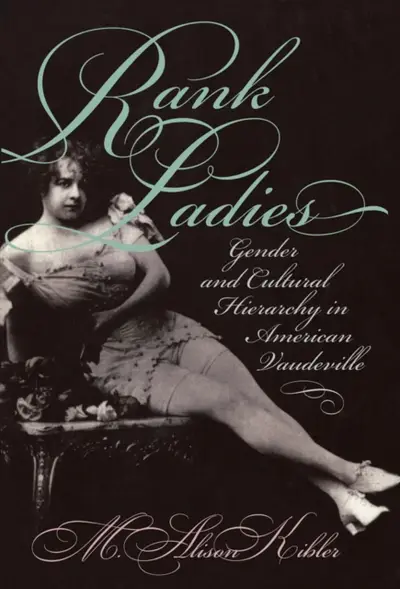
Rank Ladies
Gender and Cultural Hierarchy in American Vaudeville
Price and availability
$31.99
Available in: Andorra, Austria, Australia, Belgium, Bulgaria, Canada, Switzerland, Cyprus, Czechia, Germany, Denmark, Estonia, Spain, Finland, France, United Kingdom, Guernsey, Greece, Croatia, Hungary, Ireland, Isle of Man, Iceland, Italy, Jersey, Japan, Liechtenstein, Lithuania, Luxembourg, Latvia, Monaco, Malta, Netherlands, Norway, Poland, Portugal, Romania, Sweden, Slovenia, Slovakia, San Marino, United States, Vatican City, South Africa
Stores: US, UK, Canada, EU, Australia.
Sign in to buyThe price is re-checked by the server before payment.
For personal use under the eBook licence.
- Format
- DRM
- Not stated by the publisher
- Language
- English
- Publisher
- The University of North Carolina Press
- Published
- 12 October 2005
- ISBN
- 9798890870100
- Subjects
- USA, Variety shows, music hall, cabaret, History of the Americas, Modern history to 20th century: c 1700 to c 1900, Social & cultural history, Gender studies: women, Gender studies: women and girls
About this book
A disrobing acrobat, a female Hamlet, and a tuba-playing labor activist all these women come to life in Rank Ladies. In this comprehensive study of women in vaudeville, Alison Kibler reveals how female performers, patrons, and workers shaped the rise and fall of the most popular live entertainment at the turn of the century.Kibler focuses on the role of gender in struggles over whether high or low culture would reign in vaudeville, examining womens performances and careers in vaudeville, their status in the expanding vaudeville audience, and their activity in the vaudevillians' labor union. Respectable women were a key to vaudevilles success, she says, as entrepreneurs drew women into audiences that had previously been dominated by working-class men and recruited female artists as performers. But although theater managers publicly celebrated the cultural uplift of vaudeville and its popularity among women, in reality their houses were often hostile both to female performers and to female patrons and home to women who challenged conventional understandings of respectable behavior. Once a sign of vaudevilles refinement, Kibler says, women became associated with the decay of vaudeville and were implicated in broader attacks on mass culture as well.
Bibliographic data © Gardners Books Ltd.