PDF · English
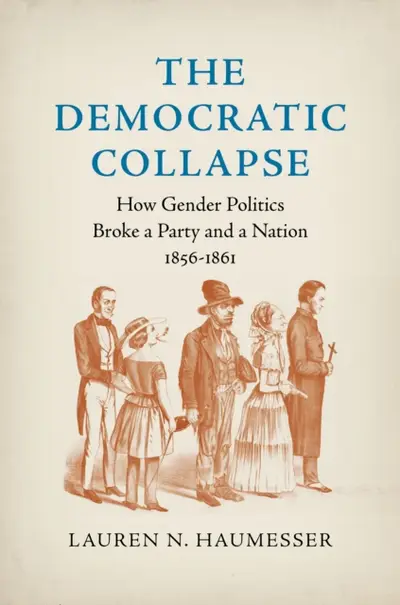
Democratic Collapse
How Gender Politics Broke a Party and a Nation, 1856-1861
Price and availability
$168.99
Available in: Andorra, Austria, Australia, Belgium, Bulgaria, Canada, Switzerland, Cyprus, Czechia, Germany, Denmark, Estonia, Spain, Finland, France, United Kingdom, Guernsey, Greece, Croatia, Hungary, Ireland, Isle of Man, Iceland, Italy, Jersey, Japan, Liechtenstein, Lithuania, Luxembourg, Latvia, Monaco, Malta, Netherlands, Norway, Poland, Portugal, Romania, Sweden, Slovenia, Slovakia, San Marino, United States, Vatican City, South Africa
Stores: US, UK, Canada, EU, Australia.
Sign in to buyThe price is re-checked by the server before payment.
For personal use under the eBook licence.
- Format
- DRM
- Not stated by the publisher
- Language
- English
- Publisher
- The University of North Carolina Press
- Published
- 8 November 2022
- ISBN
- 9798890855459
- Subjects
- USA, c 1800 to c 1900, Early modern history: c 1450/1500 to c 1700, Modern history to 20th century: c 1700 to c 1900, Military history, American Civil War, Gender studies, gender groups, Political science & theory, United States of America, USA, Gender studies, gender groups, Political science and theory, History of the Americas
About this book
This fresh examination of antebellum politics comprehensively examines the ways that gender issues and gendered discourse exacerbated fissures within the Democratic Party in the critical years between 1856 and 1861. Whereas the cultural politics of gender had bolstered Democratic unity through the 1850s, the Lecompton crisis and John Browns raid revealed that white manhood and its association with familial and national protection meant disparateand ultimately incompatiblethings in free and slave society. In fierce debates over the extension of slavery, gendered rhetoric hardened conflicts that ultimately led to the outbreak of the Civil War.Lauren Haumesser here traces how northern and southern Democrats and their partisan media organs used gender to make powerful arguments about slavery as the sectional crisis grew, from the emergence of the Republican Party to secession. Gendered charges and countercharges turned slavery into an intractable cultural debate, raising the stakes of every dispute and making compromise ever more elusive.
Bibliographic data © Gardners Books Ltd.