PDF · English
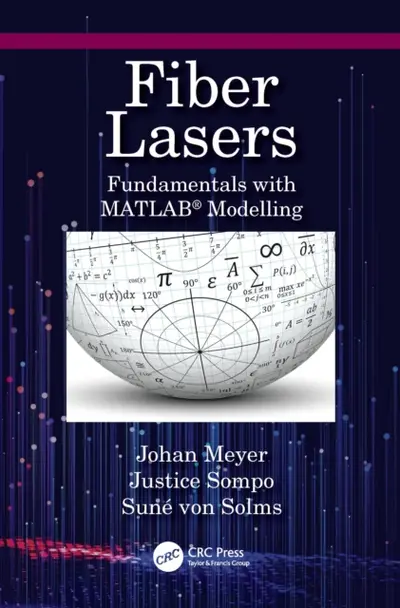
Fiber Lasers
Fundamentals with MATLAB(R) Modelling
Price and availability
$62.99
Available in: Andorra, Austria, Australia, Belgium, Bulgaria, Canada, Switzerland, Cyprus, Czechia, Germany, Denmark, Estonia, Spain, Finland, France, United Kingdom, Guernsey, Greece, Croatia, Hungary, Ireland, Isle of Man, Iceland, Italy, Jersey, Japan, Liechtenstein, Lithuania, Luxembourg, Latvia, Monaco, Malta, Netherlands, Norway, Poland, Portugal, Romania, Sweden, Slovenia, Slovakia, San Marino, United States, Vatican City, South Africa
Stores: US, UK, Canada, EU, Australia.
Sign in to buyThe price is re-checked by the server before payment.
For personal use under the eBook licence.
- Format
- DRM
- Not stated by the publisher
- Language
- English
- Publisher
- CRC Press
- Published
- 3 February 2022
- ISBN
- 9781000531961
- Subjects
- Applied optics, Fibre optics, Laser technology & holography, Laser physics, Laser technology and holography, Computer modelling and simulation
About this book
Over the past two decades, the use of fiber lasers in engineering applications has gradually become established as an engineering discipline on its own. The development of fiber lasers is mainly the result of studies from various domains like photonics, optical sensing, fiber optics, nonlinear optics, and telecommunication. Though many excellent books exist on each of these subjects, and several have been written specifically to address lasers and fiber lasers, it is still difficult to find one book where the diverse core of subjects that are central to the study of fiber laser systems are presented in simple and straight forward way. Fiber Lasers: Fundamentals with MATLAB Modelling, is an introduction to the fundamentals of fiber lasers. It provides clear explanations of physical concepts supporting the field of fiber lasers. Fiber lasers' characteristics are analyzed theoretically through simulations derived from numerical models. The authors cover fundamental principles involved in the generation of laser light through both continuous-wave (CW) and pulsing. It also covers experimental configuration and characterization for both CW and Q-switching. The authors describe the simulation of fiber laser systems and propose numerical modelling of various fiber laser schemes. MATLAB(R) modelling and numerical computational methods are used throughout the book to simulate different fiber laser system configurations. This book will be highly desirable and beneficial for both academics and industry professionals to have ample examples of fiber laser approaches that are well thought out and fully integrated with the subjects covered in the text. This book is written to address these needs.
Bibliographic data © Gardners Books Ltd.