PDF · English
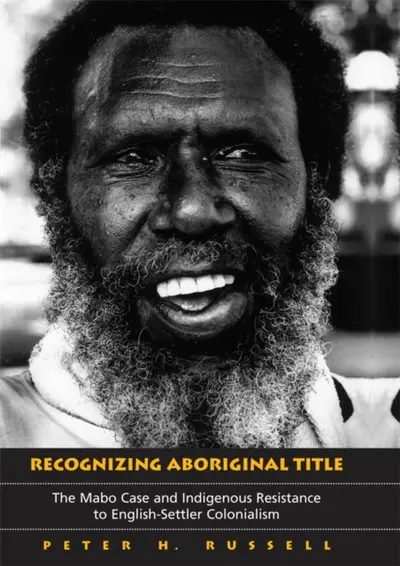
Recognizing Aboriginal Title
The Mabo Case and Indigenous Resistance to English-Settler Colonialism
Price and availability
$56.99
Available in: Andorra, Austria, Australia, Belgium, Bulgaria, Canada, Switzerland, Cyprus, Czechia, Germany, Denmark, Estonia, Spain, Finland, France, United Kingdom, Guernsey, Greece, Croatia, Hungary, Ireland, Isle of Man, Iceland, Italy, Jersey, Japan, Liechtenstein, Lithuania, Luxembourg, Latvia, Monaco, Malta, Netherlands, Norway, Poland, Portugal, Romania, Sweden, Slovenia, Slovakia, San Marino, United States, Vatican City, South Africa
Stores: US, UK, Canada, EU, Australia.
Sign in to buyThe price is re-checked by the server before payment.
For personal use under the eBook licence.
- Format
- DRM
- Not stated by the publisher
- Language
- English
- Publisher
- University of Toronto Press
- Published
- 15 December 2005
- Pages
- 450
- ISBN
- 9781442657199
- Subjects
- Australia, Australasian & Pacific history, Indigenous peoples, Land & real estate law, Australia, JBSL11, Land and real estate law / Real property law, NHM
About this book
A judicial revolution occurred in 1992 when Australia's highest court discarded a doctrine that had stood for two hundred years, that the country was a terra nullius - a land of no one - when the white man arrived. The proceedings were known as the Mabo Case, named for Eddie Koiki Mabo, the Torres Strait Islander who fought the notion that the Australian Aboriginal people did not have a system of land ownership before European colonization. The case had international repercussions, especially on the four countries in which English-settlers are the dominant population: Australia, Canada, New Zealand, and the United States. In Recognizing Aboriginal Title, Peter H. Russell offers a comprehensive study of the Mabo case, its background, and its consequences, contextualizing it within the international struggle of Indigenous peoples to overcome their colonized status. Russell weaves together an historical narrative of Mabo's life with an account of the legal and ideological premises of European imperialism and their eventual challenge by the global forces of decolonization. He traces the development of Australian law and policy in relation to Aborigines, and provides a detailed examination of the decade of litigation that led to the Mabo case. Mabo died at the age of fifty-six just five months before the case was settled. Although he had been exiled from his land over a dispute when he was a teenager, he was buried there as a hero. Recognizing Aboriginal Title is a work of enormous importance by a legal and constitutional scholar of international renown, written with a passion worthy of its subject - a man who fought hard for his people and won.
Bibliographic data © Gardners Books Ltd.