PDF · English
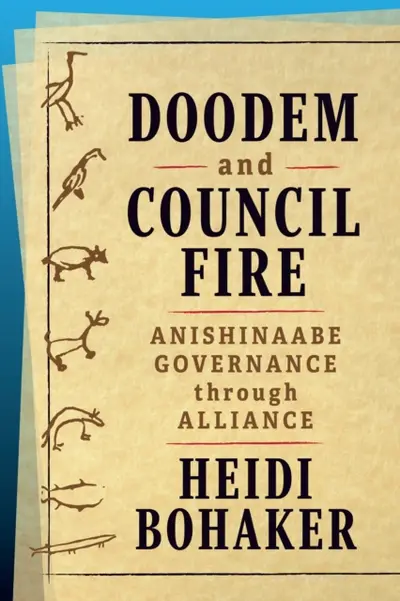
Doodem and Council Fire
Anishinaabe Governance through Alliance
Price and availability
$35.99
Available in: Andorra, Austria, Australia, Belgium, Bulgaria, Canada, Switzerland, Cyprus, Czechia, Germany, Denmark, Estonia, Spain, Finland, France, United Kingdom, Guernsey, Greece, Croatia, Hungary, Ireland, Isle of Man, Iceland, Italy, Jersey, Japan, Liechtenstein, Lithuania, Luxembourg, Latvia, Monaco, Malta, Netherlands, Norway, Poland, Portugal, Romania, Sweden, Slovenia, Slovakia, San Marino, United States, Vatican City, South Africa
Stores: US, UK, Canada, EU, Australia.
Sign in to buyThe price is re-checked by the server before payment.
For personal use under the eBook licence.
- Format
- DRM
- Not stated by the publisher
- Language
- English
- Publisher
- University of Toronto Press
- Published
- 7 December 2020
- Pages
- 304
- ISBN
- 9781442667860
- Subjects
- North America, Canada, c 1600 to c 1700, History of the Americas, Indigenous peoples, Jurisprudence & general issues, Roman law, Law & society, Legal history, Human rights & civil liberties law, North America (USA and Canada), Canada, 3MG, JBSL11, Jurisprudence and general issues, Systems of law: Roman law, Law and society, sociology of law, Legal history, Law: Human rights and civil liberties, NHK
About this book
Combining socio-legal and ethnohistorical studies, this book presents the history of doodem, or clan identification markings, left by Anishinaabe on treaties and other legal documents from the seventeenth through the nineteenth centuries. These doodems reflected fundamental principles behind Anishinaabe governance that were often ignored by Europeans, who referred to Indigenous polities in terms of tribe, nation, band, or village - classifications that failed to fully encompass longstanding cultural traditions of political authority within Anishinaabe society.Making creative use of natural history, treaty pictographs, and the Ojibwe language as an analytical tool, Doodem and Council Fire delivers groundbreaking insights into Anishinaabe law. The author asks not only what these doodem markings indicate, but what they may also reveal through their exclusions. The book also ooutlines the continuities, changes, and innovations in Anishinaabe governance through the concept of council fires and the alliances between them. Original and path-breaking, Doodem and Council Fire offers a fresh approach to Indigenous history, presenting a new interpretation grounded in a deep understanding of the nuances and distinctiveness of Anishinaabe culture and Indigenous traditions.
Bibliographic data © Gardners Books Ltd.