PDF · English
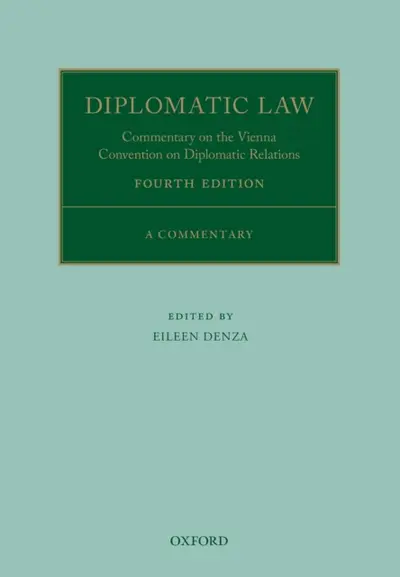
Diplomatic Law
Commentary on the Vienna Convention on Diplomatic Relations
Price and availability
$55.99
Available in: Andorra, Austria, Australia, Belgium, Bulgaria, Canada, Switzerland, Cyprus, Czechia, Germany, Denmark, Estonia, Spain, Finland, France, United Kingdom, Guernsey, Greece, Croatia, Hungary, Ireland, Isle of Man, Iceland, Italy, Jersey, Japan, Liechtenstein, Lithuania, Luxembourg, Latvia, Monaco, Malta, Netherlands, Norway, Poland, Portugal, Romania, Sweden, Slovenia, Slovakia, San Marino, United States, Vatican City, South Africa
Stores: US, UK, Canada, EU, Australia.
Sign in to buyThe price is re-checked by the server before payment.
For personal use under the eBook licence.
- Format
- DRM
- Not stated by the publisher
- Language
- English
- Publisher
- Oxford University Press
- Published
- 14 January 2016
- ISBN
- 9780191009129
- Subjects
- International relations, Diplomacy, Public international law, Diplomatic law, Diplomacy, Public international law: diplomatic law
About this book
The 1961 Vienna Convention on Diplomatic Relations has for over 50 years been central to diplomacy and applied to all forms of relations among sovereign States. Participation is almost universal. The rules giving special protection to ambassadors are the oldest established in international law and the Convention is respected almost everywhere. But understanding it as a living instrument requires knowledge of its background in customary international law, of the negotiating history which clarifies many of its terms and the subsequent practice of states and decisions of national courts which have resolved other ambiguities. Diplomatic Law provides this in-depth Commentary. The book is an essential guide to changing methods of modern diplomacy and shows how challenges to its regime of special protection for embassies and diplomats have been met and resolved. It is used by ministries of foreign affairs and cited by domestic courts world-wide. The book analyzes the reasons for the widespread observance of the Convention rules and why in the special case of communications - where there is flagrant violation of their special status - these reasons do not apply. It describes how abuse has been controlled and how the immunities in the Convention have survived onslaught by those claiming that they should give way to conflicting entitlements to access to justice and the desire to punish violators of human rights. It describes how the duty of diplomats not to interfere in the internal affairs of the host State is being narrowed in the face of the communal international responsibility to monitor and uphold human rights.
Bibliographic data © Gardners Books Ltd.