EPUB · English
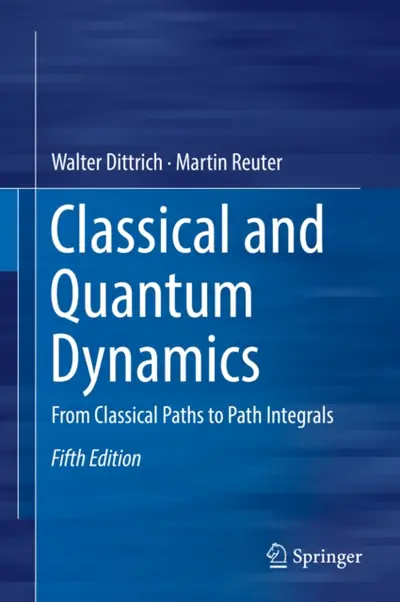
Classical and Quantum Dynamics
From Classical Paths to Path Integrals
Price and availability
$75.99
Available in: Andorra, Austria, Australia, Belgium, Bulgaria, Canada, Switzerland, Cyprus, Czechia, Germany, Denmark, Estonia, Spain, Finland, France, United Kingdom, Guernsey, Greece, Croatia, Hungary, Ireland, Isle of Man, Iceland, Italy, Jersey, Japan, Liechtenstein, Lithuania, Luxembourg, Latvia, Monaco, Malta, Netherlands, Norway, Poland, Portugal, Romania, Sweden, Slovenia, Slovakia, San Marino, United States, Vatican City, South Africa
Stores: US, UK, Canada, EU, Australia.
Sign in to buyThe price is re-checked by the server before payment.
For personal use under the eBook licence.
- Format
- EPUB
- DRM
- Not stated by the publisher
- Language
- English
- Publisher
- Springer International Publishing
- Published
- 11 May 2017
- ISBN
- 9783319582986
- Subjects
- Mathematical modelling, Classical mechanics, Nuclear physics, Particle & high-energy physics, Quantum physics (quantum mechanics & quantum field theory), Mathematical physics, Physics, Classical mechanics, Quantum physics (quantum mechanics and quantum field theory), Mathematical / Computational / Theoretical physics
About this book
Graduate students who wish to become familiar with advanced computational strategies in classical and quantum dynamics will find in this book both the fundamentals of a standard course and a detailed treatment of the time-dependent oscillator, Chern-Simons mechanics, the Maslov anomaly and the Berry phase, to name just a few topics. Well-chosen and detailed examples illustrate perturbation theory, canonical transformations and the action principle, and demonstrate the usage of path integrals.The fifth edition has been revised and enlarged to include chapters on quantum electrodynamics, in particular, Schwinger's proper time method and the treatment of classical and quantum mechanics with Lie brackets and pseudocanonical transformations. It is shown that operator quantum electrodynamics can be equivalently described with c-numbers, as demonstrated by calculating the propagation function for an electron in a prescribed classical electromagnetic field.
Bibliographic data © Gardners Books Ltd.