PDF · English
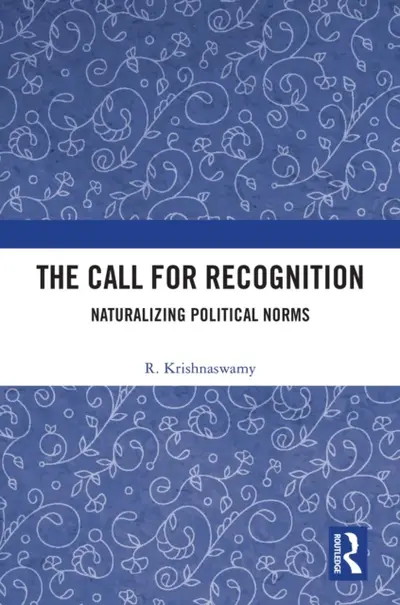
Call for Recognition
Naturalizing Political Norms
Price and availability
$58.99
Available in: Andorra, Austria, Australia, Belgium, Bulgaria, Canada, Switzerland, Cyprus, Czechia, Germany, Denmark, Estonia, Spain, Finland, France, United Kingdom, Guernsey, Greece, Croatia, Hungary, Ireland, Isle of Man, Iceland, Italy, Jersey, Japan, Liechtenstein, Lithuania, Luxembourg, Latvia, Monaco, Malta, Netherlands, Norway, Poland, Portugal, Romania, Sweden, Slovenia, Slovakia, San Marino, United States, Vatican City, South Africa
Stores: US, UK, Canada, EU, Australia.
Sign in to buyThe price is re-checked by the server before payment.
For personal use under the eBook licence.
- Format
- DRM
- Not stated by the publisher
- Language
- English
- Publisher
- Taylor & Francis
- Published
- 24 March 2023
- ISBN
- 9781000856859
- Subjects
- Philosophy of language, Sociolinguistics, Social & political philosophy, Society & culture: general, Conservatism & right-of-centre democratic ideologies, Political structures: democracy, Jurisprudence & philosophy of law, Political science and theory, Methods, theory and philosophy of law, Ethics and moral philosophy
About this book
This book builds a case for how social norms are neither mere conventions nor are they merely anthropological phenomena, which are relativistic. In other words, it talks about how socio-political norms are built out of our natural social behaviour but at the same time also have objective normative validity.The volume puts forth an alternative model called the recognitional model which can help us address some of the socio-political concerns we face in today's world. It addresses the problem with a purely legalistic framework of addressing social injustice in that law, due its universalistic assumptions, regarding human nature, tends to glide over the particular differences that might exist between people. This book discusses how we know that in our daily lives, we value people not only because that person is a legal human being but also because that person is our father, mother, our teacher, etc. There is a whole network of acts of social respect that we engage in with the other in our social sphere which the legal framework can't quite capture. This volume sheds light on the political consequence of legal reasoning in that it is formalistic in the sense that legal relations can't successfully codify the immediate epistemic context from which social identities emerge.An introspective work, this book will be of great interest to scholars and researchers of linguistics, political philosophy, law and human rights, and social theory.
Bibliographic data © Gardners Books Ltd.