PDF · English
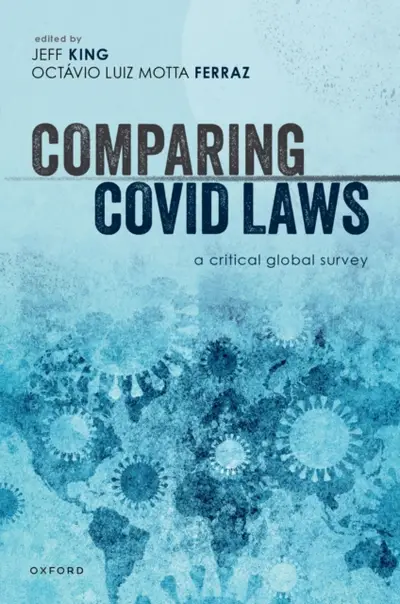
Comparing Covid Laws
A Critical Global Survey
Price and availability
$140.99
Available in: Andorra, Austria, Australia, Belgium, Bulgaria, Canada, Switzerland, Cyprus, Czechia, Germany, Denmark, Estonia, Spain, Finland, France, United Kingdom, Guernsey, Greece, Croatia, Hungary, Ireland, Isle of Man, Iceland, Italy, Jersey, Japan, Liechtenstein, Lithuania, Luxembourg, Latvia, Monaco, Malta, Netherlands, Norway, Poland, Portugal, Romania, Sweden, Slovenia, Slovakia, San Marino, United States, Vatican City, South Africa
Stores: US, UK, Canada, EU, Australia.
Sign in to buyThe price is re-checked by the server before payment.
For personal use under the eBook licence.
- Format
- DRM
- Not stated by the publisher
- Language
- English
- Publisher
- Oxford University Press
- Published
- 12 March 2026
- ISBN
- 9780198899907
- Subjects
- 21st century, Law & society, Constitutional & administrative law, Public health & safety law, Infectious & contagious diseases, Law and society, sociology of law, Constitutional and administrative law: general, Public health and safety law
About this book
The Covid-19 pandemic brought about both the most serious public health crisis as well as, for many states, the most profound public interventions in individual liberties in the last century. Comparing Covid Laws: A Critical Global Survey examines the evidence of how fifty-three countries from around the world fared at providing an efficacious response within a framework respecting the rule of law, rights, and democratic government. The book draws primarily on data gathered within the Lex-Atlas: Covid-19 (LAC19) project, a worldwide collaboration of jurists that produced the fifty-three detailed and structurally identical country reports published in The Oxford Compendium of National Legal Responses to Covid-19. This volume contains the considered critical judgments of the editorial committee of the Compendium. Over the course of twelve chapters, the text examines a wide range of topics including; the use of emergency powers to address the health crisis, the role of courts, the impact on women's rights, on privacy, on workers and on the right to protest. It also discusses how pandemic responses unfolded in particular ways in cities, federal countries and authoritarian settings. Editors Jeff King and Octvio Luiz Motta Ferraz, as well as the contributors, were motivated by the belief, defended in the introduction of the book, that a good pandemic response is not simply one that achieves better outcomes in terms of morbidity and mortality, a topic that dominated discussions throughout the health crisis. A good pandemic response, they argue, is also one that pursues these goals in a manner that respects democracy, the rule of law, and human rights.
Bibliographic data © Gardners Books Ltd.