EPUB · English
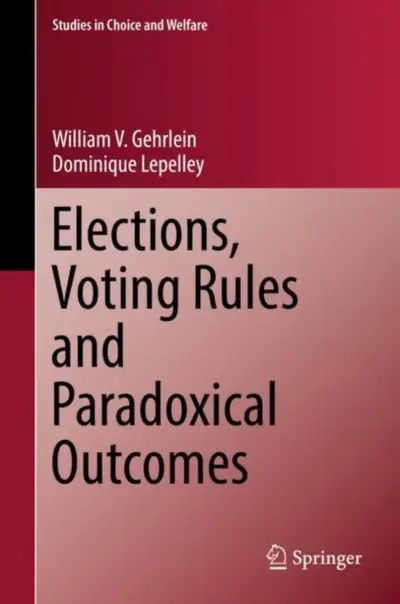
Elections, Voting Rules and Paradoxical Outcomes
Price and availability
$134.99
Available in: Andorra, Austria, Australia, Belgium, Bulgaria, Canada, Switzerland, Cyprus, Czechia, Germany, Denmark, Estonia, Spain, Finland, France, United Kingdom, Guernsey, Greece, Croatia, Hungary, Ireland, Isle of Man, Iceland, Italy, Jersey, Japan, Liechtenstein, Lithuania, Luxembourg, Latvia, Monaco, Malta, Netherlands, Norway, Poland, Portugal, Romania, Sweden, Slovenia, Slovakia, San Marino, United States, Vatican City, South Africa
Stores: US, UK, Canada, EU, Australia.
Sign in to buyThe price is re-checked by the server before payment.
For personal use under the eBook licence.
- Format
- EPUB
- DRM
- Not stated by the publisher
- Language
- English
- Publisher
- Springer International Publishing
- Published
- 14 October 2017
- ISBN
- 9783319646596
- Subjects
- Elections & referenda, Economic theory & philosophy, Management decision making, Operational research, Game theory, Elections and referenda / suffrage, Welfare economics, Management decision making, Operational research, Game theory
About this book
This monograph studies voting procedures based on the probability that paradoxical outcomes like the famous Condorcet Paradox might exist. It is well known that hypothetical examples of many different paradoxical election outcomes can be developed, but this analysis examines factors that are related to the process by which voters form their preferences on candidates that will significantly reduce the likelihood that such voting paradoxes will ever actually be observed. It is found that extreme forms of voting paradoxes should be uncommon events with a small number of candidates. Another consideration is the propensity of common voting rules to elect the Condorcet Winner, which is widely accepted as the best choice as the winner, when it exists. All common voting rules are found to have identifiable scenarios for which they perform well on the basis of this criterion. But, Borda Rule is found to consistently work well at electing the Condorcet Winner, while the other voting rules have scenarios where they work poorly or have a very small likelihood of electing a different candidate than Borda Rule. The conclusions of previous theoretical work are presented in an expository format and they are validated with empirically-based evidence. Practical implications of earlier studies are also developed.
Bibliographic data © Gardners Books Ltd.