PDF · English
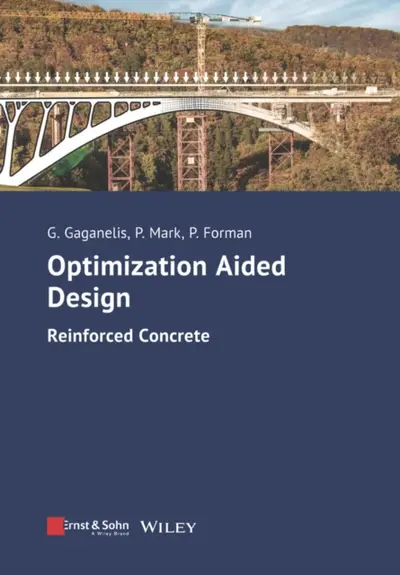
Optimization Aided Design
Reinforced Concrete
Price and availability
$81.99
Available in: Andorra, Austria, Australia, Belgium, Bulgaria, Canada, Switzerland, Cyprus, Czechia, Germany, Denmark, Estonia, Spain, Finland, France, United Kingdom, Guernsey, Greece, Croatia, Hungary, Ireland, Isle of Man, Iceland, Italy, Jersey, Japan, Liechtenstein, Lithuania, Luxembourg, Latvia, Monaco, Malta, Netherlands, Norway, Poland, Portugal, Romania, Sweden, Slovenia, Slovakia, San Marino, United States, Vatican City, South Africa
Stores: US, UK, Canada, EU, Australia.
Sign in to buyThe price is re-checked by the server before payment.
For personal use under the eBook licence.
- Format
- DRM
- Not stated by the publisher
- Language
- English
- Publisher
- Wiley
- Published
- 5 January 2022
- ISBN
- 9783433610718
- Subjects
- Civil engineering, surveying & building, Civil engineering, surveying and building
About this book
Optimization Aided Design: Reinforced Concrete Concrete is the most used building material. Its main component, cement, however, accounts production- related for up to 10 % of global CO2 emissions and is therefore a major contributor to human-induced climate change. Due to its low tensile strength, concrete must be further enhanced in tension with adequate reinforcement, such as steel. Producing the latter therefore additionally impacts the environment. Consequently, reducing the material amount for design and construction of structures, thus lowering material- and transport-induced emissions, represents a key element to climate protection. In this context, meeting the essential requirements - sustainability, serviceability, durability - is yet indispensable. The book presents innovative optimization aided design methods for concrete structures. Mathematical optimization is applied to practical problems of structural concrete at each level: from external, through internal structure identification to cross-section design. It is shown how to design resource-efficient structures following the flux of forces, how to optimally adapt reinforcement layouts to the internal force flow, and how to efficiently cope with demanding cross-sectional design tasks such as biaxial bending. The optimization aided design methods are discussed in detail and described vividly. They are independent of standards, concrete material (normal to ultra-high performance) and reinforcement type (steel fibers to carbon bars), thus universally applicable. The book illustrates the different approaches with numerous figures and calculation examples. Existing applications in structural engineering are presented to demonstrate the potential of optimization aided design concepts, including ultra-lightweight hybrid beams, thin concrete solar collectors, and improved reinforcement layouts for tunnel lining segments.
Bibliographic data © Gardners Books Ltd.