EPUB · English
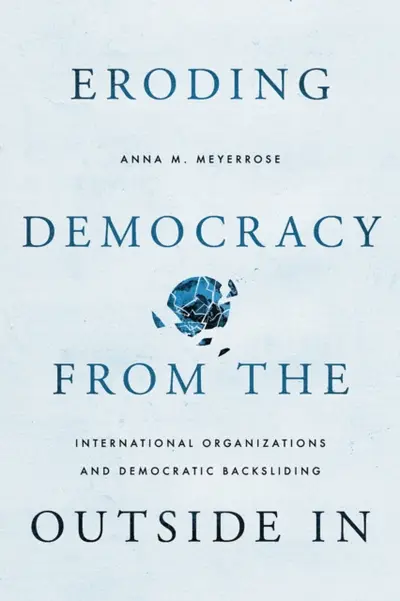
Eroding Democracy from the Outside In
International Organizations and Democratic Backsliding
Price and availability
$22.99
Available in: Andorra, Austria, Australia, Belgium, Bulgaria, Canada, Switzerland, Cyprus, Czechia, Germany, Denmark, Estonia, Spain, Finland, France, United Kingdom, Guernsey, Greece, Croatia, Hungary, Ireland, Isle of Man, Iceland, Italy, Jersey, Japan, Liechtenstein, Lithuania, Luxembourg, Latvia, Monaco, Malta, Netherlands, Norway, Poland, Portugal, Romania, Sweden, Slovenia, Slovakia, San Marino, United States, Vatican City, South Africa
Stores: US, UK, Canada, EU, Australia.
Sign in to buyThe price is re-checked by the server before payment.
For personal use under the eBook licence.
- Format
- EPUB
- DRM
- Not stated by the publisher
- Language
- English
- Publisher
- Oxford University Press
- Published
- 23 December 2025
- ISBN
- 9780197816455
- Subjects
- EU (European Union), Political science & theory, Political structure & processes, Political structures: democracy, EU & European institutions, EU (European Union), Political science and theory, Political structure and processes, Political structures / systems: democracy, JPSN
About this book
The end of the Cold War gave way to a fundamental shift in the structure of the international system. It was an era characterized above all by liberal triumphalism in which Western politicians and policymakers turned to international organizations (IOs) to spread and reinforce liberal values. These IOs, backed by the West, proliferated at exceedingly high rates, with democracies in particular becoming fully integrated members. Scholars agreed with policymakers, finding overwhelming evidence that these IOs were positive forces for democracy, and for several decades liberal democracy appeared ascendant. However, beginning around 2010, liberal democracy's forward march abruptly halted, and ongoing evidence of democratic backsliding ---an historically unprecedented phenomenon in which democratically elected officials erode liberal democratic institutions--- calls into question the post-Cold War narrative of liberal democratic triumphalism. What explains democracy's sudden reversal of fortune and the emergence of this new form of democratic regression on the heels of unmatched international integration and support for liberal democracy? Eroding Democracy from the Outside In proposes a novel international-level theory of democratic backsliding. In the decades after the Soviet Union fell, IOs became not only much more common, but a certain subset of these organizations also gained unprecedented power and influence over domestic affairs and substantive, highly salient economic and political policy outcomes. One unintended consequence of this increased delegation of economic and political policy authority to powerful IOs has been that over time core domestic representative institutions, such as political parties and legislatures, have been eroded, while power has been increasingly concentrated in the hands of executives who represent their states at the international level. These weak institutions, unable to either represent citizens' wide-ranging interests or act as a check on growing executive power, have paved the way for would-be autocrats to consolidate their hold on the state. The result all too often has been democratic backsliding.
Bibliographic data © Gardners Books Ltd.