EPUB · English
Ardor
Price and availability
Not sold in this region
Available in: Andorra, Austria, Australia, Belgium, Bulgaria, Switzerland, Cyprus, Czechia, Germany, Denmark, Estonia, Spain, Finland, France, United Kingdom, Guernsey, Greece, Croatia, Hungary, Ireland, Isle of Man, Iceland, Italy, Jersey, Japan, Liechtenstein, Lithuania, Luxembourg, Latvia, Monaco, Malta, Netherlands, Norway, Poland, Portugal, Romania, Sweden, Slovenia, Slovakia, San Marino, Vatican City, South Africa
Stores: UK, EU, Australia. Not available in the United States store.
This title cannot be bought in this store yet: its supplier terms, territorial rights or price are still being confirmed.
For personal use under the eBook licence.
- Format
- EPUB
- DRM
- Not stated by the publisher
- Language
- English
- Publisher
- Penguin Books Ltd
- Published
- 18 November 2014
- ISBN
- 9780141971810
- Subjects
- India, Oriental & Indian philosophy, Hindu sacred texts, Criticism & exegesis of sacred texts, East Asian and Indian philosophy, Hinduism: sacred texts and revered writings, Criticism and exegesis of sacred texts
About this book
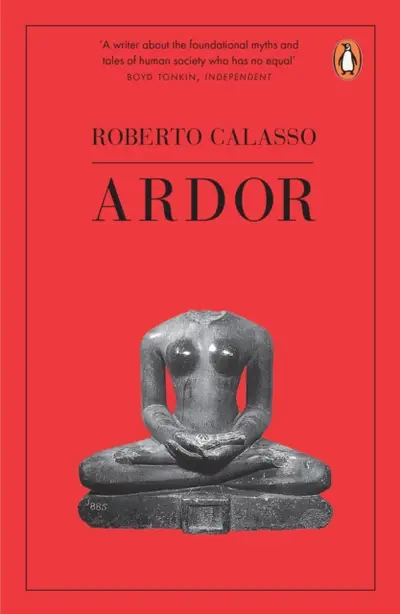
In this revelatory volume, Roberto Calasso, whom the Paris Review has called 'a literary institution', explores the ancient texts known as the Vedas. Little is known about the Vedic people who lived more than three thousand years ago in northern India: they left behind almost no objects, images, ruins. They created no empires. Even the hallucinogenic plant, the soma, which appears at the centre of some of their rituals, has not been identified with any certainty. Only a 'Parthenon of words' remains: verses and formulations suggesting a daring understanding of life. 'If the Vedic people had been asked why they did not build cities,' writes Calasso, 'they could have replied: we did not seek power, but rapture.' This is the ardor of the Vedic world, a burning intensity that is always present, both in the mind and in the cosmos. With his signature erudition and profound sense of the past, Calasso explores the enigmatic web of ritual and myth that define the Vedas. Often at odds with modern thought, he shows how these texts illuminate the nature of consciousness more than neuroscientists have been able to offer us up to now. Following the 'hundred paths' of the Satapatha Brahmana, an impressive exegesis of Vedic ritual, Ardor indicates that it may be possible to reach what is closest by passing through that which is most remote, as 'the whole of Vedic India was an attempt to think further'.
Bibliographic data © Gardners Books Ltd.