PDF · English
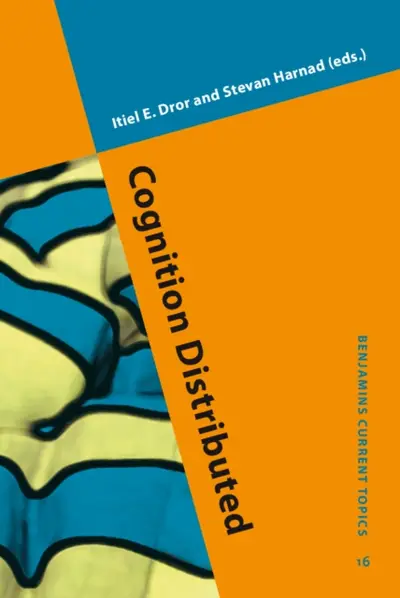
Cognition Distributed
How cognitive technology extends our minds
Price and availability
$108.99
Available in: Andorra, Austria, Australia, Belgium, Bulgaria, Canada, Switzerland, Cyprus, Czechia, Germany, Denmark, Estonia, Spain, Finland, France, United Kingdom, Guernsey, Greece, Croatia, Hungary, Ireland, Isle of Man, Iceland, Italy, Jersey, Japan, Liechtenstein, Lithuania, Luxembourg, Latvia, Monaco, Malta, Netherlands, Norway, Poland, Portugal, Romania, Sweden, Slovenia, Slovakia, San Marino, United States, Vatican City, South Africa
Stores: US, UK, Canada, EU, Australia.
Sign in to buyThe price is re-checked by the server before payment.
For personal use under the eBook licence.
- Format
- DRM
- Not stated by the publisher
- Language
- English
- Publisher
- John Benjamins Publishing Company
- Published
- 17 December 2008
- Pages
- 274
- ISBN
- 9789027289643
- Subjects
- Cognition & cognitive psychology, Cognition and cognitive psychology
About this book
Our species has been a maker and user of tools for over two million years, but "e;cognitive technology"e; began with language. Cognition is thinking, and thinking has been "e;distributed"e; for at least the two hundred millennia that we have been using speech to interact and collaborate, allowing us to do collectively far more than any of us could have done individually. The invention of writing six millennia ago and print six centuries ago has distributed cognition still more widely and quickly, among people as well as their texts. But in recent decades something radically new has been happening: Advanced cognitive technologies, especially computers and the Worldwide Web, are beginning to redistribute cognition in unprecedented ways, not only among people and static texts, but among people and dynamical machines. This not only makes possible new forms of human collaboration, but new forms of cognition. This book examines the nature and prospects of distributed cognition, providing a conceptual framework for understanding it, and showcasing case studies of its development. This volume was originally published as a Special Issue of Pragmatics & Cognition (14:2, 2006).
Bibliographic data © Gardners Books Ltd.