PDF · root
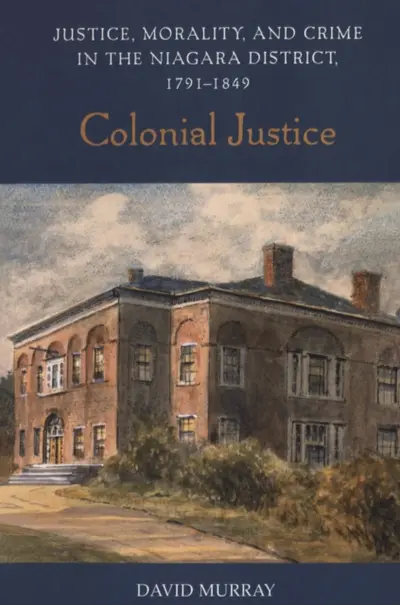
Colonial Justice
Justice, Morality, and Crime in the Niagara District, 1791-1849
Price and availability
$41.99
Available in: Andorra, Austria, Australia, Belgium, Bulgaria, Canada, Switzerland, Cyprus, Czechia, Germany, Denmark, Estonia, Spain, Finland, France, United Kingdom, Guernsey, Greece, Croatia, Hungary, Ireland, Isle of Man, Iceland, Italy, Jersey, Japan, Liechtenstein, Lithuania, Luxembourg, Latvia, Monaco, Malta, Netherlands, Norway, Poland, Portugal, Romania, Sweden, Slovenia, Slovakia, San Marino, United States, Vatican City, South Africa
Stores: US, UK, Canada, EU, Australia.
Sign in to buyThe price is re-checked by the server before payment.
For personal use under the eBook licence.
- Format
- DRM
- Not stated by the publisher
- Language
- root
- Publisher
- University of Toronto Press
- Published
- 15 December 2002
- Pages
- 298
- ISBN
- 9781442623408
- Subjects
- Canada, c 1800 to c 1900, History: specific events & topics, Criminal law & procedure, Canada, 3MN, Criminal law: procedure and offences, NHT
About this book
In 1791 when the Constitutional Act created a legislative assembly for Upper Canada, the colonists and their British rulers decreed that the operating criminal justice system in the area be adopted from England, to avoid any undue influence from the nearby United States. In this new study of early Canadian law, David Murray has delved into the court records of the Niagara District, one of the richest sets of criminal court records surviving from Upper Canada, to analyze the criminal justice system in the district during the first half of the nineteenth century. Murray explores how far local characteristics affected the operation of a criminal justice system transplanted from England; his analysis includes how legal processes affected Upper Canadian morality, the treatment of the insane, welfare cases, crimes committed in the district, and an examination of the roles of the Niagara magistrates, constables, and juries. Murray concludes by arguing that while the principles and culture of British justice were firmly implanted in the Niagara district, this did not prevent justice from being unequal, especially for women and visible minorities. Integrating the stories of the individuals caught up in the legal system, Murray explores law from a local perspective, and illuminates how the Niagara region's criminal justice system operated under hybrid influences from both Britain and the United States.
Bibliographic data © Gardners Books Ltd.