PDF · English
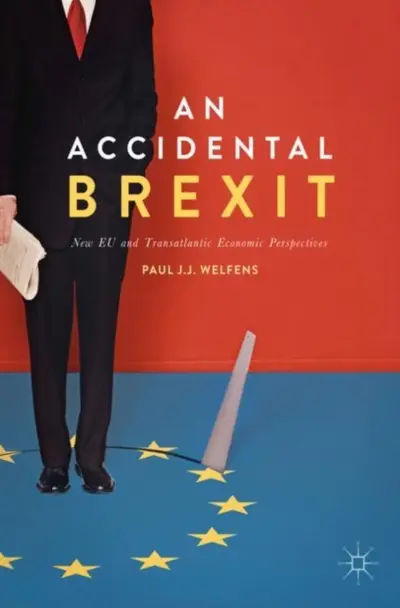
Accidental Brexit
New EU and Transatlantic Economic Perspectives
Price and availability
$32.99
Available in: Andorra, Austria, Australia, Belgium, Bulgaria, Canada, Switzerland, Cyprus, Czechia, Germany, Denmark, Estonia, Spain, Finland, France, United Kingdom, Guernsey, Greece, Croatia, Hungary, Ireland, Isle of Man, Iceland, Italy, Jersey, Japan, Liechtenstein, Lithuania, Luxembourg, Latvia, Monaco, Malta, Netherlands, Norway, Poland, Portugal, Romania, Sweden, Slovenia, Slovakia, San Marino, United States, Vatican City, South Africa
Stores: US, UK, Canada, EU, Australia.
Sign in to buyThe price is re-checked by the server before payment.
For personal use under the eBook licence.
- Format
- DRM
- Not stated by the publisher
- Language
- English
- Publisher
- Springer International Publishing
- Published
- 31 August 2017
- ISBN
- 9783319582719
- Subjects
- EU (European Union), International relations, Economics, finance, business & management, Economic theory & philosophy, Macroeconomics, Monetary economics, International economics, Political economy, Public finance, Taxation, International business, EU (European Union), International relations, Economics, Economic theory and philosophy, Macroeconomics, International economics, Political economy, Civil service and public sector
About this book
This book analyzes how the EU referendum in the United Kingdom came to pass and what the foreseeable consequences are for the UK, Europe, US and world economy. The Brexit decision represents a momentous event for Europe, which weakens the EU and shifts the global balance of power. Welfens argues the EU has lost its appeal and is not in keeping with the twenty-first century, which is being shaped by Asia and digital innovations. The subject of immigration from EU countries played a key role in the Brexit decision, with an anti-EU campaign that was profoundly biased. The estimated impact of the referendum was deeply distorted by the broadly inadequate information produced by the Cameron government, which omitted the expected 10 percent loss in income caused by leaving the EU. With this this information, there could have been a clear pro-EU majority. In the absence of a second referendum, one cannot know what the British electorate really wants. Both the Brexit decision and new Presidentof the United States Donald Trump's approach to European disintegration dynamics also raise serious questions about the future of transatlantic relations.
Bibliographic data © Gardners Books Ltd.