PDF · English
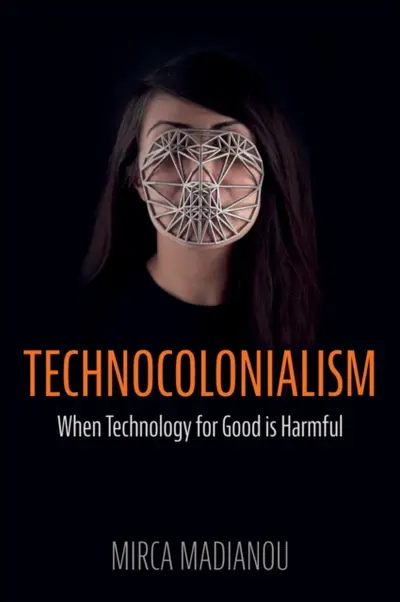
Technocolonialism
When Technology for Good is Harmful
Price and availability
$74.99
Available in: Andorra, Austria, Australia, Belgium, Bulgaria, Canada, Switzerland, Cyprus, Czechia, Germany, Denmark, Estonia, Spain, Finland, France, United Kingdom, Guernsey, Greece, Croatia, Hungary, Ireland, Isle of Man, Iceland, Italy, Jersey, Japan, Liechtenstein, Lithuania, Luxembourg, Latvia, Monaco, Malta, Netherlands, Norway, Poland, Portugal, Romania, Sweden, Slovenia, Slovakia, San Marino, United States, Vatican City, South Africa
Stores: US, UK, Canada, EU, Australia.
Sign in to buyThe price is re-checked by the server before payment.
For personal use under the eBook licence.
- Format
- DRM
- Not stated by the publisher
- Language
- English
- Publisher
- Polity Press
- Published
- 16 October 2024
- ISBN
- 9781509565290
- Subjects
- Society & culture: general, JB
About this book
Winner of the 2026 International Communication Association Outstanding Book AwardWinner of the 2026 Philosophy, Theory and Critique (PTC-ICA) Book AwardWith over 300 million people in need of humanitarian assistance, and with emergencies and climate disasters becoming more common, AI and big data are being championed as forces for good and as solutions to the complex challenges of the aid sector.This book argues, however, that digital innovation engenders new forms of violence and entrenches power asymmetries between the global South and North. Madianou develops a new concept, technocolonialism, to capture how the convergence of digital developments with humanitarian structures, state power and market forces reinvigorates and reshapes colonial legacies. The concept of technocolonialism shifts the attention to the constitutive role that digital infrastructures, data and AI play in accentuating inequities between aid providers and people in need.Drawing on ten years of research on the uses of digital technologies in humanitarian operations, the book examines a range of practices: from the normalization of biometric technologies and the datafication of humanitarian operations to experimentation in refugee camps, which are treated as laboratories for technological pilots. In so doing, the book opens new ground in the fields of humanitarianism and critical AI studies, and in the debates in postcolonial studies, by highlighting the fundamental role of digital technologies in reworking colonial genealogies.
Bibliographic data © Gardners Books Ltd.