EPUB · English
Synthetic Socialism
Plastics and Dictatorship in the German Democratic Republic
- History
- Society & social sciences
- Politics & law
- Economics, business & finance
- Technology & engineering
- Arts, music & film
Price and availability
$40.99
Available in: Andorra, Austria, Australia, Belgium, Bulgaria, Canada, Switzerland, Cyprus, Czechia, Germany, Denmark, Estonia, Spain, Finland, France, United Kingdom, Guernsey, Greece, Croatia, Hungary, Ireland, Isle of Man, Iceland, Italy, Jersey, Japan, Liechtenstein, Lithuania, Luxembourg, Latvia, Monaco, Malta, Netherlands, Norway, Poland, Portugal, Romania, Sweden, Slovenia, Slovakia, San Marino, United States, Vatican City, South Africa
Stores: US, UK, Canada, EU, Australia.
Sign in to buyThe price is re-checked by the server before payment.
For personal use under the eBook licence.
- Format
- EPUB
- DRM
- Not stated by the publisher
- Language
- English
- Publisher
- The University of North Carolina Press
- Published
- 1 September 2012
- ISBN
- 9781469606774
- Subjects
- Germany, East Germany, DDR, 20th century, c 1945 to c 2000 (Post-war period), European history, Postwar 20th century history, from c 1945 to c 2000, Social & cultural history, Industrialisation & industrial history, Cultural studies, Socialism & left-of-centre democratic ideologies, Chemical industries, Technical design, History of engineering & technology, Germany, Design, Industrial and commercial arts, illustration, European history, Technical design, History of engineering and technology
About this book
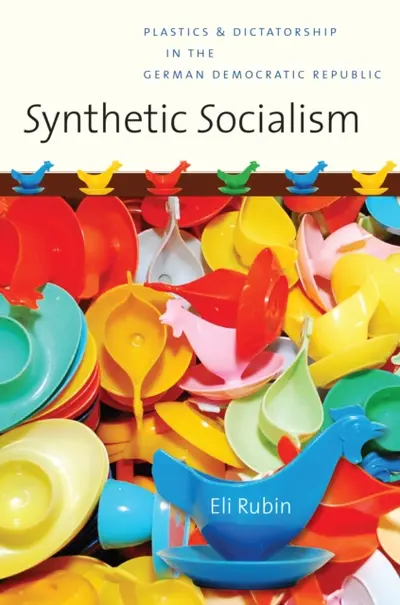
Eli Rubin takes an innovative approach to consumer culture to explore questions of political consensus and consent and the impact of ideology on everyday life in the former East Germany. Synthetic Socialism explores the history of East Germany through the production and use of a deceptively simple material: plastic. Rubin investigates the connections between the communist government, its Bauhaus-influenced designers, its retooled postwar chemical industry, and its general consumer population. He argues that East Germany was neither a totalitarian state nor a niche society but rather a society shaped by the confluence of unique economic and political circumstances interacting with the concerns of ordinary citizens.To East Germans, Rubin says, plastic was a high-technology material, a symbol of socialisms scientific and economic superiority over capitalism. Most of all, the state and its designers argued, plastic goods were of a particularly special quality, not to be thrown away like products of the wasteful West. Rubin demonstrates that this argument was accepted by the mainstream of East German society, for whom the modern, socialist dimension of a plastics-based everyday life had a deep resonance.
Bibliographic data © Gardners Books Ltd.