PDF · English
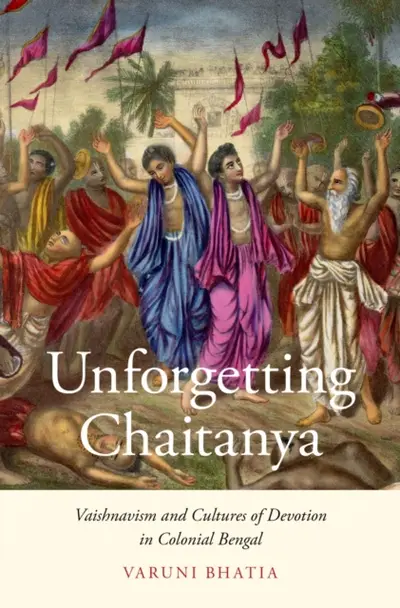
Unforgetting Chaitanya
Vaishnavism and Cultures of Devotion in Colonial Bengal
Price and availability
$106.99
Available in: Andorra, Austria, Australia, Belgium, Bulgaria, Canada, Switzerland, Cyprus, Czechia, Germany, Denmark, Estonia, Spain, Finland, France, United Kingdom, Guernsey, Greece, Croatia, Hungary, Ireland, Isle of Man, Iceland, Italy, Jersey, Japan, Liechtenstein, Lithuania, Luxembourg, Latvia, Monaco, Malta, Netherlands, Norway, Poland, Portugal, Romania, Sweden, Slovenia, Slovakia, San Marino, United States, Vatican City, South Africa
Stores: US, UK, Canada, EU, Australia.
Sign in to buyThe price is re-checked by the server before payment.
For personal use under the eBook licence.
- Format
- DRM
- Not stated by the publisher
- Language
- English
- Publisher
- Oxford University Press
- Published
- 9 August 2017
- ISBN
- 9780190686253
- Subjects
- India, Asian history, Colonialism & imperialism, Religion & beliefs, History of religion, Hinduism, NHF, NHTQ, QR, QRAX, QRD
About this book
What role do pre-modern religious traditions play in the formation of modern secular identities? In Unforgetting Chaitanya, Varuni Bhatia examines late-nineteenth-century transformations of Bengali Vaishnavism-a vibrant and multifaceted religious tradition that traces its origins to the fifteenth century Krishna devotee Chaitanya (1486-1533). Drawing on an extensive body of hitherto unexamined archival material, Bhatia finds that both religious modernizers and secular voices among the Bengali middle-class invoked Chaitanya, portraying him simultaneously as a local hero, a Hindu reformer, and as God almighty. She argues that these claims should be understood in relation to the recovery of a "e;pure"e; Bengali culture and history in a period of nascent, but rising, anti-colonialism in the region. Who is a true Vaishnava? In the late nineteenth century, this question assumed urgency as debates around questions of authenticity appeared prominently in the Bengali public sphere. These debates went on for years, even decades, causing unbridgeable rifts in personal friendships and tarnishing reputations of established scholars. Underlying these debates was the question of authoritative Bengali Vaishnavism and its role in the long-term constitution of Bengali culture and society. At stake, argues Bhatia, was the very nature and composition of an indigenously-derived modernity inscribed through the politics of authenticity, which allowed an influential section of Hindu, upper-caste Bengalis to excavate their own explicitly Hindu pasts in order to find a people's history, a religious reformer, a casteless Hindu sect, the richest examples of Bengali literature, and a sophisticated expression of monotheistic religion.
Bibliographic data © Gardners Books Ltd.