EPUB · English
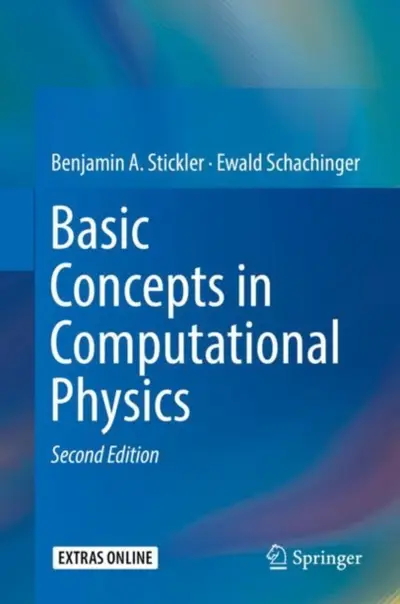
Basic Concepts in Computational Physics
Price and availability
$67.99
Available in: Andorra, Austria, Australia, Belgium, Bulgaria, Canada, Switzerland, Cyprus, Czechia, Germany, Denmark, Estonia, Spain, Finland, France, United Kingdom, Guernsey, Greece, Croatia, Hungary, Ireland, Isle of Man, Iceland, Italy, Jersey, Japan, Liechtenstein, Lithuania, Luxembourg, Latvia, Monaco, Malta, Netherlands, Norway, Poland, Portugal, Romania, Sweden, Slovenia, Slovakia, San Marino, United States, Vatican City, South Africa
Stores: US, UK, Canada, EU, Australia.
Sign in to buyThe price is re-checked by the server before payment.
For personal use under the eBook licence.
- Format
- EPUB
- DRM
- Not stated by the publisher
- Language
- English
- Publisher
- Springer International Publishing
- Published
- 21 March 2016
- ISBN
- 9783319272658
- Subjects
- Calculus & mathematical analysis, Probability & statistics, Mathematical physics, Numerical analysis, Mathematical / Computational / Theoretical physics, Quantum and theoretical chemistry, Maths for engineers
About this book
This new edition is a concise introduction to the basic methods of computational physics. Readers will discover the benefits of numerical methods for solving complex mathematical problems and for the direct simulation of physical processes. The book is divided into two main parts: Deterministic methods and stochastic methods in computational physics. Based on concrete problems, the first part discusses numerical differentiation and integration, as well as the treatment of ordinary differential equations. This is extended by a brief introduction to the numerics of partial differential equations. The second part deals with the generation of random numbers, summarizes the basics of stochastics, and subsequently introduces Monte-Carlo (MC) methods. Specific emphasis is on MARKOV chain MC algorithms. The final two chapters discuss data analysis and stochastic optimization. All this is again motivated and augmented by applications from physics. Inaddition, the book offers a number of appendices to provide the reader with information on topics not discussed in the main text. Numerous problems with worked-out solutions, chapter introductions and summaries, together with a clear and application-oriented style support the reader. Ready to use C++ codes are provided online.
Bibliographic data © Gardners Books Ltd.