PDF · English
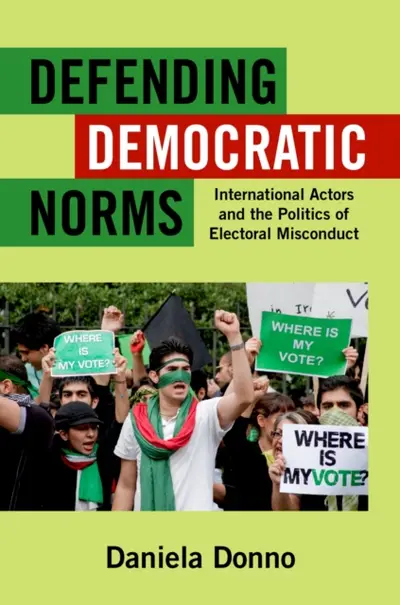
Defending Democratic Norms
International Actors and the Politics of Electoral Misconduct
Price and availability
$29.99
Available in: Andorra, Austria, Australia, Belgium, Bulgaria, Canada, Switzerland, Cyprus, Czechia, Germany, Denmark, Estonia, Spain, Finland, France, United Kingdom, Guernsey, Greece, Croatia, Hungary, Ireland, Isle of Man, Iceland, Italy, Jersey, Japan, Liechtenstein, Lithuania, Luxembourg, Latvia, Monaco, Malta, Netherlands, Norway, Poland, Portugal, Romania, Sweden, Slovenia, Slovakia, San Marino, United States, Vatican City, South Africa
Stores: US, UK, Canada, EU, Australia.
Sign in to buyThe price is re-checked by the server before payment.
For personal use under the eBook licence.
- Format
- DRM
- Not stated by the publisher
- Language
- English
- Publisher
- Oxford University Press
- Published
- 2 August 2013
- ISBN
- 9780199991303
- Subjects
- Comparative politics, Elections & referenda, Public administration, International relations, Comparative politics, Elections and referenda / suffrage, Public administration / Public policy, International relations
About this book
Although nearly every country in the world today holds multiparty elections, these contests are often blatantly unfair. For governments, electoral misconduct is a tempting but also a risky practice, because it represents a violation of Although nearly every country in the world today holds multiparty elections, these contests are often blatantly unfair. For governments, electoral misconduct is a tempting but also a risky practice, because it represents a violation of international standards for free and fair elections. In Defending Democratic Norms, Daniela Donno examines how international actors respond to these norm violations. Which governments are punished for manipulating elections? Does international norm enforcement make a difference? Donno shows that although enforcement is selective and relatively rare, when international actors do employ tools of conditionality, diplomacy, mediation and shaming in response to electoral misconduct, they can have transformative effects on both the quality and outcome of elections. Specifically, enforcement works by empowering the domestic opposition and increasing the government's incentives to reform institutions of electoral management and oversight. These effects depend, however, on the presence of a viable opposition movement, as well as on the strength and credibility of the enforcement effort itself. The book shows that regional international organizations possess unique sources of leverage and legitimacy that make them the most consistently effective norm defenders, even compared to more materially powerful actors like the United States. Drawing on an original dataset from almost 700 elections and incorporating case studies from the Dominican Republic, Serbia, Armenia, Kenya and Cambodia, Defending Democratic Norms is a bold new theory of international norm enforcement that demonstrates the importance of active international intervention in domestic politics.
Bibliographic data © Gardners Books Ltd.