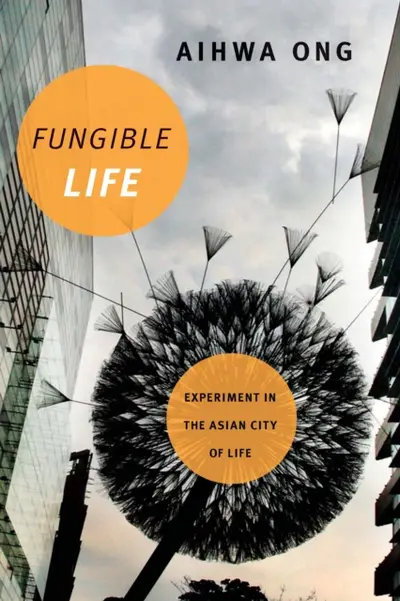
PDF · English
Fungible Life
Experiment in the Asian City of Life
Price and availability
$47.99
Available in: Andorra, Austria, Australia, Belgium, Bulgaria, Canada, Switzerland, Cyprus, Czechia, Germany, Denmark, Estonia, Spain, Finland, France, United Kingdom, Guernsey, Greece, Croatia, Hungary, Ireland, Isle of Man, Iceland, Italy, Jersey, Japan, Liechtenstein, Lithuania, Luxembourg, Latvia, Monaco, Malta, Netherlands, Norway, Poland, Portugal, Romania, Sweden, Slovenia, Slovakia, San Marino, United States, Vatican City, South Africa
Stores: US, UK, Canada, EU, Australia.
Sign in to buyThe price is re-checked by the server before payment.
For personal use under the eBook licence.
- Format
- DRM
- Not stated by the publisher
- Language
- English
- Publisher
- Duke University Press
- Published
- 13 October 2016
- ISBN
- 9780822373643
- Subjects
- Asia, Asian history, Ethical issues: scientific & technological developments, Social & cultural anthropology, ethnography, Philosophy of science, Impact of science & technology on society, JBFV5, Social and cultural anthropology, NHF, Philosophy of science, Impact of science and technology on society
About this book
In Fungible Life Aihwa Ong explores the dynamic world of cutting-edge bioscience research, offering critical insights into the complex ways Asian bioscientific worlds and cosmopolitan sciences are entangled in a tropical environment brimming with the threat of emergent diseases. At biomedical centers in Singapore and China scientists map genetic variants, disease risks, and biomarkers, mobilizing ethnicized "e;Asian"e; bodies and health data for genomic research. Their differentiation between Chinese, Indian, and Malay DNA makes fungible Singapore's ethnic-stratified databases that come to "e;represent"e; majority populations in Asia. By deploying genomic science as a public good, researchers reconfigure the relationships between objects, peoples, and spaces, thus rendering "e;Asia"e; itself as a shifting entity. In Ong's analysis, Asia emerges as a richly layered mode of entanglements, where the population's genetic pasts, anxieties and hopes, shared genetic weaknesses, and embattled genetic futures intersect. Furthermore, her illustration of the contrasting methods and goals of the Biopolis biomedical center in Singapore and BGI Genomics in China raises questions about the future direction of cosmopolitan science in Asia and beyond.
Bibliographic data © Gardners Books Ltd.