PDF · English
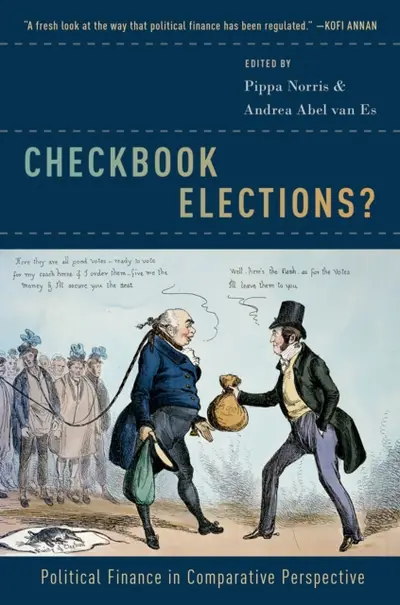
Checkbook Elections?
Political Finance in Comparative Perspective
Price and availability
$36.99
Available in: Andorra, Austria, Australia, Belgium, Bulgaria, Canada, Switzerland, Cyprus, Czechia, Germany, Denmark, Estonia, Spain, Finland, France, United Kingdom, Guernsey, Greece, Croatia, Hungary, Ireland, Isle of Man, Iceland, Italy, Jersey, Japan, Liechtenstein, Lithuania, Luxembourg, Latvia, Monaco, Malta, Netherlands, Norway, Poland, Portugal, Romania, Sweden, Slovenia, Slovakia, San Marino, United States, Vatican City, South Africa
Stores: US, UK, Canada, EU, Australia.
Sign in to buyThe price is re-checked by the server before payment.
For personal use under the eBook licence.
- Format
- DRM
- Not stated by the publisher
- Language
- English
- Publisher
- Oxford University Press
- Published
- 4 May 2016
- ISBN
- 9780190603625
- Subjects
- Comparative politics, Elections & referenda, Political structures: democracy, Public opinion & polls, Comparative politics, Elections and referenda / suffrage, Political structures / systems: democracy, JPWA
About this book
Money is essential to the functioning of electoral politics, yet regulating its appropriate use raises complex and controversial challenges in countries around the world. Both long-established democracies and emerging economies have been continually plagued by problems of financial malfeasance, graft, corruption, and cronyism. To throw new light on these important challenges, this book addresses three related questions: (1) what types of public policies are commonly used in attempts to regulate the role of money in politics?, (2) what triggers landmark finance reforms? and, (3) above all, what works, what fails, and why - when countries implement reforms? Checkbook Elections? presents an original theory for understanding policies regulating political finance, reflecting the degree to which laws are laissez-faire or guided by state intervention. Each chapter is written by an area specialist and collectively cover long-established democracies as well as hybrid regimes, affluent post-industrial societies (Sweden, the United States, Britain, and Japan), major emerging economies (Russia, Brazil, and South Africa) and developing societies (India and Indonesia).
Bibliographic data © Gardners Books Ltd.