PDF · English
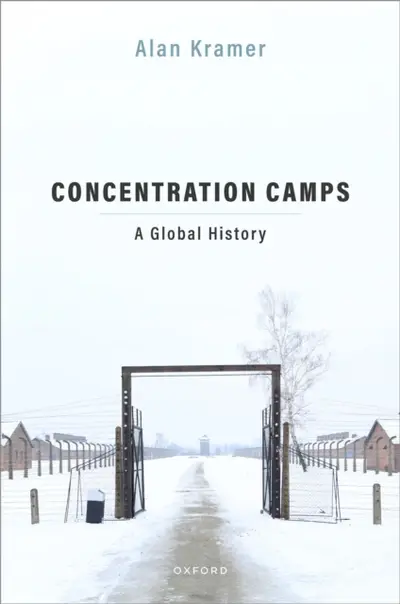
Concentration Camps
A Global History
Price and availability
$37.99
Available in: Andorra, Austria, Australia, Belgium, Bulgaria, Canada, Switzerland, Cyprus, Czechia, Germany, Denmark, Estonia, Spain, Finland, France, United Kingdom, Guernsey, Greece, Croatia, Hungary, Ireland, Isle of Man, Iceland, Italy, Jersey, Japan, Liechtenstein, Lithuania, Luxembourg, Latvia, Monaco, Malta, Netherlands, Norway, Poland, Portugal, Romania, Sweden, Slovenia, Slovakia, San Marino, United States, Vatican City, South Africa
Stores: US, UK, Canada, EU, Australia.
Sign in to buyThe price is re-checked by the server before payment.
For personal use under the eBook licence.
- Format
- DRM
- Not stated by the publisher
- Language
- English
- Publisher
- Oxford University Press
- Published
- 24 March 2025
- ISBN
- 9780192520906
- Subjects
- Europe, c 1939 to c 1945 (including WW2), 21st century, General & world history, 20th century history: c 1900 to c 2000, 21st century history: from c 2000 -, The Holocaust, Second World War, Prisoners of war, Europe, General and world history, The Holocaust, Second World War
About this book
A global and comprehensive history of a modern institution of inhumanity. In popular perception concentration camps are synonymous with genocide and Nazi racial extermination. Yet concentration camps were and are a global phenomenon, not restricted to Nazi Germany, used at times even by democracies, with an astonishing range of functions. Drawing together a wide range of multi-lingual archival research and synthesising a broad secondary literature, Alan Kramer provides here a comprehensive history of concentration camps, charting their first establishment at the beginning of the twentieth century on the colonial periphery, through their most extreme and inhuman instances in the mid-twentieth century, to their continued use today. Concentration camps are shown to be a truly transnational phenomenon that emerged both simultaneously (within and between imperial spheres Britain, Spain, the USA, and Germany around 1900), and diachronically (from then to the First World War, the Gulag, and Nazi camps). Such camps existed (and exist) under a variety of regimes, often concomitant with empire-building by revolutionary dictatorships, as sites of genocide, mass murder, and performative violence, but also as central elements of utopian schemes of social and racial transformation. Integrating the perspective of perpetrators and the victims and contextualising them within the historiography of other carceral institutions, the book will reshape the way we think about concentration camps as part of modern civilization, past and present.
Bibliographic data © Gardners Books Ltd.